
there's no shortage of guides on what to do to get monetised.
this is a guide to what guarantees you never will - the step-by-step path to a rejected monetisation review and 12 months grinding an audience that generates zero revenue.
follow these steps carefully. plenty of channels are running all of them right now without realising it.
step 1: treat watch hours as a numbers game
to qualify for monetisation, you need 4,000 watch hours.
the common strategy: upload as much as possible, as fast as possible, and grind toward the number.

this is the perfect approach if your goal is to hit 4,000 watch hours on content youtube's classifier has already flagged as low-quality before you even apply.
here's what the watch-hour grind hides: when you apply for monetisation, youtube reviews your recent content. not just whether you hit the metrics. whether your content passes the authenticity and quality checks that the partner programme requires.
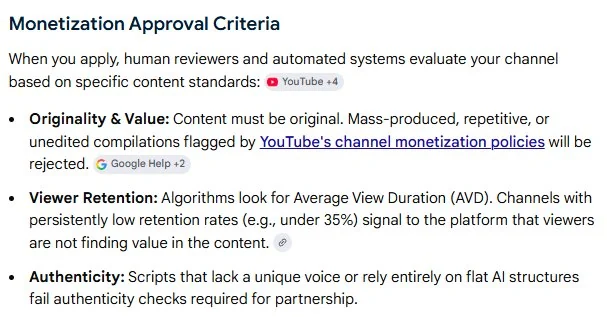
channels that grind 4,000 watch hours on videos with 35% retention and flat AI script structure apply for monetisation, get reviewed, and get denied.
then they wait 30 days and apply again with the same content. denied again.
they had the watch hours.
what they didn't have was content that could survive the review.
step 2: use a raw AI prompt for every script
this one is the most efficient path to a failed monetisation review.
open claude or any other model. type: "write me a 10-minute script about [topic] for a faceless youtube channel."
publish the output directly (or with minimal editing).
repeat for 40 videos.
youtube's content review process in 2026 checks transcripts for authenticity signals. the july 2025 policy update is explicit: content at risk includes "fully AI-generated content with minimal human involvement."
a raw AI prompt with no editorial direction, no research layer, no retention brief, and no authenticity constraints produces output with specific structural fingerprints:
- flat rhythm with no deliberate variation
- generic transition phrases that cluster in AI output ("now, let's move on to..." / "in conclusion...")
- information delivery with no genuine point of view
- vocabulary that flags as machine-generated
human reviewers at youtube are trained to spot these signals. the classifier is trained on them too. if you want to guarantee rejection, the raw prompt approach is your fastest route.
step 3: open every video the same way
"hey guys, welcome back to the channel. in today's video, i'm going to be talking about..."
this one single sentence burns 8 seconds of your hook window saying nothing to nobody.
the first 30 seconds of your video is where 40% of your viewers make their stay-or-leave decision. the viewer clicked on your thumbnail expecting a specific experience. they're running a trust check: does this creator know what i came here for?
"hey guys, welcome back" answers nothing. it delays the confirmation the viewer needs. the trust check fails. they leave.
at 40% viewer loss in the first 30 seconds, your video will never get distributed beyond the initial seed audience. 4,000 watch hours becomes essentially impossible. monetisation review becomes irrelevant because you never have enough content that qualifies.
and if somehow you do hit the metrics, the first video the reviewer watches starts with "hey guys, welcome back." the review is shaped by that impression from second one.
step 4: pick your niche based on RPM data, then ignore retention
high RPM niches: finance, legal, software, B2B. some run $15-40 CPM. the math looks incredible.
so you start a finance channel, upload 50 videos, and wonder why you're generating $12/month at 4,000 watch hours.
here's what the RPM optimisation spreadsheet didn't tell you: RPM is meaningless below a certain retention threshold.
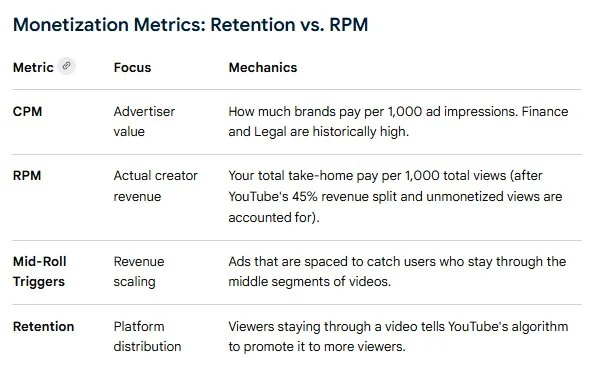
youtube pays on watch time, not views. the mid-roll ads that carry most of your revenue fire at the 30-40% and 60-70% marks of a video. a viewer who leaves at the 25-second mark generates zero mid-roll revenue.
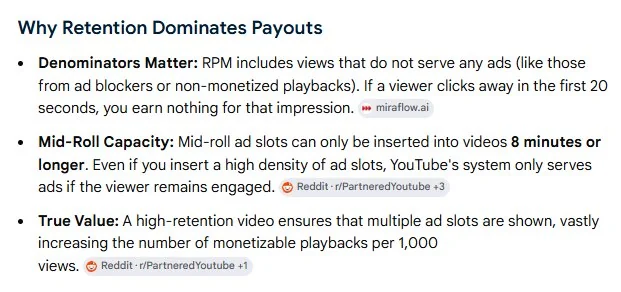
a finance channel with 38% retention at the 30-second mark generates less revenue per upload than a true crime channel with 72% retention, even though the CPM is three times higher.
optimise for RPM before you fix retention and you've built a channel that generates maximum revenue per viewer who stays, on a base of viewers who aren't staying.
step 5: never foreshadow the grand payoff
your title made a promise. "how i made $50K in 2 months with one faceless channel" is a big promise.
put the actual payoff at the 11-minute mark of a 12-minute video. don't reference it again between the hook and the delivery.
by minute 11, 80% of your viewers have already left without getting what they clicked for.
they feel deceived. they leave a negative watch signal. they don't subscribe. they don't watch again.
youtube's recommendation system picks up that viewers who clicked your video didn't stay. it stops recommending it. you get fewer impressions. your watch hours drop.
you apply for monetisation with 40 videos where 80% of viewers left before the payoff. the reviewer watches two of them and makes a decision.
if you wanted to engineer a monetisation rejection, this is one of the most reliable methods available.
step 6: treat all content formats the same
a true crime script and an educational explainer script are not the same thing.
they run on different hook frameworks, different pacing rhythms, different curiosity chaining structures.
true crime hooks work on the character-concept-stakes framework. they open in media res. they use forbidden knowledge and dramatic stakes to hold attention.
educational hooks work on the target-transformation-stakes framework. they lead with the viewer's situation. they use specificity and loss aversion to hold attention.
use an educational hook on a true crime channel and the video feels like you're trying to sell something. viewers leave at second 20. retention crashes.
use a true crime hook on an educational channel and the video feels clickbaity. viewers click away when they realise they came to learn and you're telling them a story.
either way, the retention data looks the same: cliff at 20 seconds. the monetisation reviewer sees the same thing: this content isn't holding anyone.
step 7: skip the middle section
this is the genius move.
spend all your energy on the hook. deliver the first piece of value. then let the middle section of the video run at whatever quality it runs at.

the middle section is minutes 3-8. this is where most channels bleed viewers in a slow, invisible decline that shows up on the retention graph as a gradual slope.
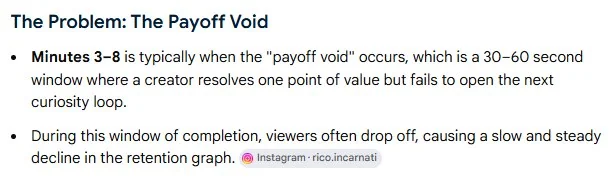
the creator sees the gradual slope and thinks "maybe the video was too long." they cut the next video shorter. the slope is still there.
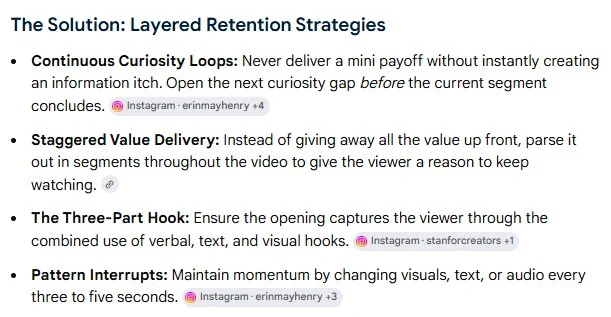
the gradual slope in minutes 3-8 is the payoff void. the creator delivered a mini payoff and then moved on without opening the next curiosity gap. there's a 30-60 second window where the viewer is in a state of completion with nothing pulling them forward.
40% of your viewers are leaving in this window across a 12-minute video. that's 40% of your watch hours gone from the middle alone.
apply for monetisation with this retention shape and the reviewer is looking at the same graph you are. they're making the same conclusion: this content doesn't retain viewers.
the belief shift mid-article
you've been reading this and recognising yourself in some of these steps.
that's intentional.
monetisation is a scriptwriting problem, full stop. every step above is a scriptwriting failure that compounds into a monetisation failure. it was never the thing creators blame - the upload count, the niche, the algorithm's attention.
the creators who clear monetisation review fast have one thing in common: their scripts are built on retention architecture that produces the watch time metrics a reviewer can't deny.
joey monetised in one video. 863,000 views from a single script. 69,600 watch hours. the monetisation review was a formality.
RK monetised in 3.5 hours after his first major upload. 490,000+ views. the retention data made the decision for youtube's reviewer before a human ever looked at it.
ed started from $0 in january. $14,500 in month one. $33,900 in month two. two faceless channels, both monetised, both scaling.
none of them got there by uploading more or chasing a hotter niche.
the scripts held retention well enough that monetisation was just the numbers catching up to what the videos were already doing.
if you want to understand the specific retention principles behind those results, i cover them in detail in the scriptwriting newsletter at fyreinteractive.co/newsletter.
and if you want the full system built on 8,000+ scripts of pattern data - 22 skill files including the authenticity audit that keeps your scripts clear of youtube's classifier - grab FacelessOS at fyreinteractive.co/facelessos
if you want to stop following the steps above and start building scripts that make monetisation inevitable, go to fyreinteractive.co/facelessos
(8,000+ scripts. $5M+ generated for clients. 22 skill files trained on pattern data across 50+ niches.)
haris
keep reading
Put this into every script you write
FacelessOS is 22 skill files built from 8,000+ scripts across 50+ niches. It works with any AI. 300+ creators are using it. $699 one-time for Files, $1,199 for FacelessOS+. No subscription.
Get FacelessOS