the panic on my timeline for the last few weeks has been something else.
thousands of creators convinced their channels are dead. people switching voiceover providers at 2am. threads about stripping watermarks. the entire faceless creator community treating an audio transparency tag like a kill switch.
i've read every take. i've gone through the actual policy documents. i've cross-referenced them against the 200+ creator scripts i've audited in the past few months. and i need to tell you something that almost nobody in this conversation is saying clearly:
the watermark is not the thing that kills your channel. your script is.
and if you don't understand that distinction, you will spend the next six months optimising the wrong variable while youtube quietly removes your monetisation for the right one.
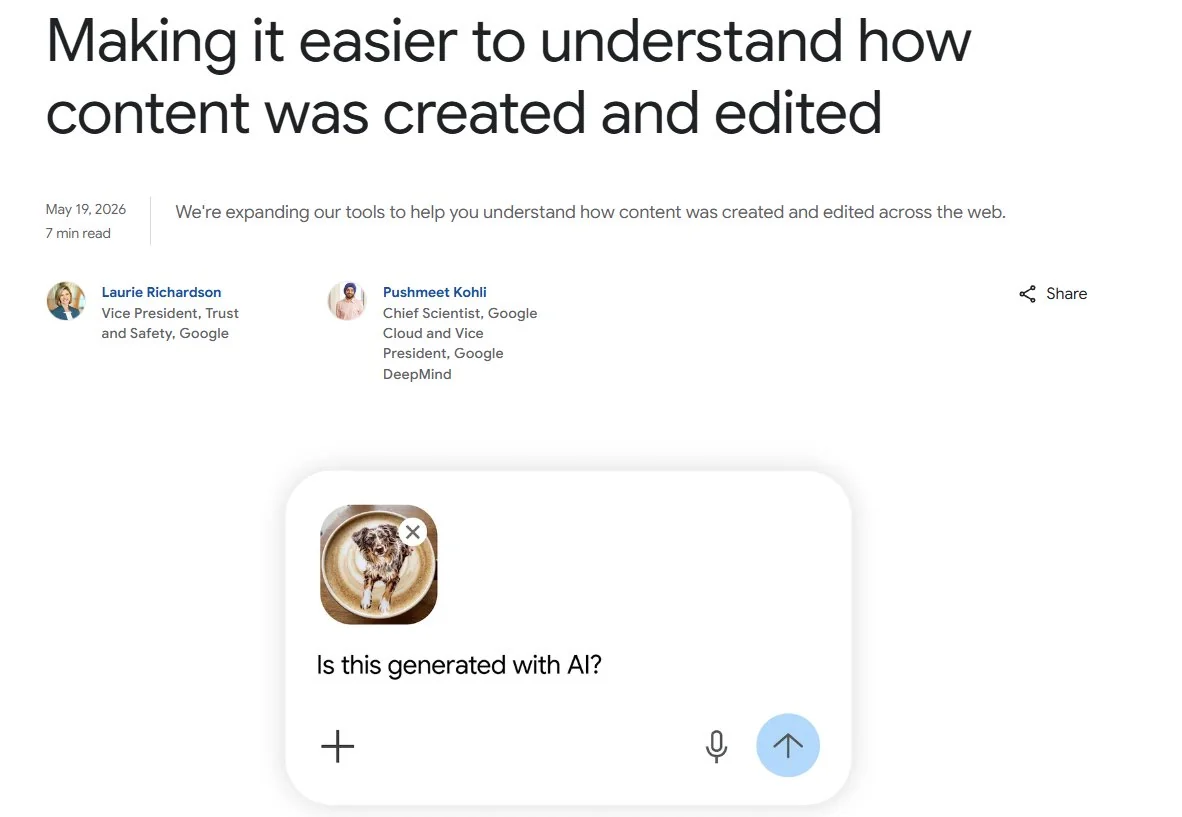
what SynthID actually does (and doesn't do)
here's the technical reality. the watermark embeds into the audio waveform at the generation level. it survives compression, re-encoding, and editing. you cannot strip it. you cannot convert it out. it is in the file.
this part of the panic is correct.
but here's where the analysis falls apart: detection and enforcement are two different things. youtube has not announced a single new enforcement action tied specifically to the watermark. knowing that a voiceover is AI-generated is not the same thing as penalising a video for it.
youtube already knew most faceless channels used AI voiceovers. the watermark formalises what was already obvious. it doesn't create new enforcement power - it creates transparency data.
and the creators who've actually been getting demonetised, the ones i've audited, the ones i've seen lose channels in the past year, they were caught on their transcripts, not their audio.
what youtube is actually reading
i audited scripts from over 200 faceless creators in the past few months. the ones who got denied monetisation had one thing in common, and it wasn't their voiceover provider.
their scripts matched the structural patterns that mass-produced content farms produce. same generic hook structures. same flat pacing. same AI rhythm that doesn't vary across the video. same absence of genuine editorial direction.
youtube reads your words. it sees your video. it analyses your transcript for structural patterns that signal zero human involvement. the waveform tells youtube the voice is AI. what gets you demonetised is the script telling youtube the thinking is AI.
the july 2025 policy update is explicit about this. content at risk of demonetisation includes: videos with AI voiceovers and zero personal commentary or storytelling. fully AI-generated content with minimal human involvement. notice what the policy is describing. it's describing the thinking layer, not the audio layer.
the distinction youtube is drawing is human creativity enhanced by AI versus AI replacing human creativity. the watermark measures the tool. the script reveals which side of that line you're on.
the two types of faceless channel (and which one survives)
there's been a lot of good conversation about splitting faceless channels into two categories, and i agree with the split even if i disagree with where people think the line is.
type one: commodity faceless. stock footage, AI voice, wikipedia rewrites, no point of view, no editorial direction, no genuine research. these channels are collapsing. they were always going to collapse. the watermark accelerated a process that was already in motion.
type two: editorial faceless. real research. strong angles. a consistent narrator perspective. scripts that have an actual point of view embedded in their structure. these channels get stronger as the commodity layer disappears.
but here's what most people get wrong about the line between type one and type two: it's drawn at the script. not the voiceover or editing.
the script is the blueprint of the video. that is the video. your b-roll is just your script made visual. your voiceover is just your script made audible. if the script has no genuine human thinking in it, the watermark on the audio is the least of your problems.
and this is why switching voiceover providers doesn't fix anything. you can move to a provider with no watermark today. if your script still produces the same flat pacing, the same generic hook structures, the same absence of editorial direction, youtube's transcript analysis will still find you. just without the audio flag.
the three checks that actually determine whether your channel survives
i've been saying this since january and i'll say it again more directly now.
your channel lives or dies on three things your script either passes or fails.
first: does your sentence rhythm vary and sound natural? flat, even-length sentences with identical structure across a 10-minute script is one of the clearest signals that no human was meaningfully involved in the creation. human writers don't write at a constant rhythm. they speed up during intense moments and slow down during story passages. the variation is organic. AI-generated scripts have no natural reason to vary. unless they're trained on data that teaches them to.
second: does every section have a structural purpose? a script that strings together information without genuine editorial architecture, no curiosity chains, no payoff loops, no escalating stakes, tells youtube that the content was assembled rather than created. the question isn't whether each fact is accurate. it's whether the structure reflects a human decision about what to say, when to say it, and why.
third: does the script have a voice that's yours, not a default? generic AI writing has a recognisable signature. certain vocabulary patterns, certain transition constructions, certain ways of building sentences that cluster regardless of topic or niche. a script that reads as default AI output, regardless of how accurate the information is, signals that the creator was not genuinely involved in the creative process.
these three checks are what determine your channel's fate. not which provider you use. not whether you disclose. not whether you strip the watermark or switch to a tool that hasn't been flagged yet.
if you want a chill place to monitor how the policy keeps evolving and get early takes on what it means for your scripts specifically, i cover it in the newsletter at fyreinteractive.co/newsletter - new breakdown every week.
what this means for creators who are actually good
the SynthID conversation has a useful side effect that nobody is talking about: it's clearing the floor.
every creator who panics and pivots to the next unwatermarked tool is continuing to produce the same quality of content with a different audio provider. they're not solving the problem. they're delaying the inevitable while burning time and energy that could have gone into the actual variable that matters.
every creator who understands that the script is the differentiator gets to operate in a market where the commodity layer is being removed by policy enforcement. the competition isn't disappearing. the low-effort competition is.
the channels that survive this, the ones that are going to print in 2026 and 2027, are the ones building scripts that pass the three checks above. scripts with genuine editorial direction. hooks that don't read as generic AI output. pacing that varies because the structure demands it, not because someone added variation arbitrarily.
this is what i built FacelessOS to produce: 22 skill files trained on 8,000+ real faceless scripts, encoding the patterns of scripts that actually hold retention and pass youtube's content checks. the anti-slop layer isn't a nice-to-have. after the july 2025 update, it's the difference between a channel that scales and a channel that gets demonetised.
the watermark tells youtube the voice is AI. your script tells youtube whether a human was actually thinking.
make sure your script is passing the right test.
if you want the system that runs all three checks automatically and produces scripts built on 8,000+ patterns of high-retention faceless content, grab FacelessOS at fyreinteractive.co/facelessos
(8,000+ scripts. $5M+ generated for clients. 22 skill files trained on pattern data across 50+ niches.)
haris
keep reading
Put this into every script you write
FacelessOS is 22 skill files built from 8,000+ scripts across 50+ niches. It works with any AI. 300+ creators are using it. $699 one-time for Files, $1,199 for FacelessOS+. No subscription.
Get FacelessOS