
i've audited over 200 faceless channels in the past year.
channels in "dead" niches printing $10K/mo. channels in "hot" niches stuck at 400 views. channels that switched niche three times in six months and got worse with each pivot.
and the single most common belief holding all of them back is the same:
"if i just find the right niche, everything will click."
it won't.
i'm not saying niche doesn't matter. i'm saying niche is the last variable you should be optimising when you're stuck. and the fact that you're pivoting to new niches while your scripts stay broken is why you're still stuck.
here's what's actually happening.
the niche pivot trap
when a channel isn't growing, the creator looks for something to change.
they can't see their script quality problem. scripts feel like the intangible, subjective part of the operation. thumbnails feel fixable. niches feel switchable. upload schedules feel optimisable.
so they switch niche. the first two videos in the new niche do slightly better because novelty bumps click-through rate. then they plateau at the same retention numbers they had before.
because the script hasn't changed.
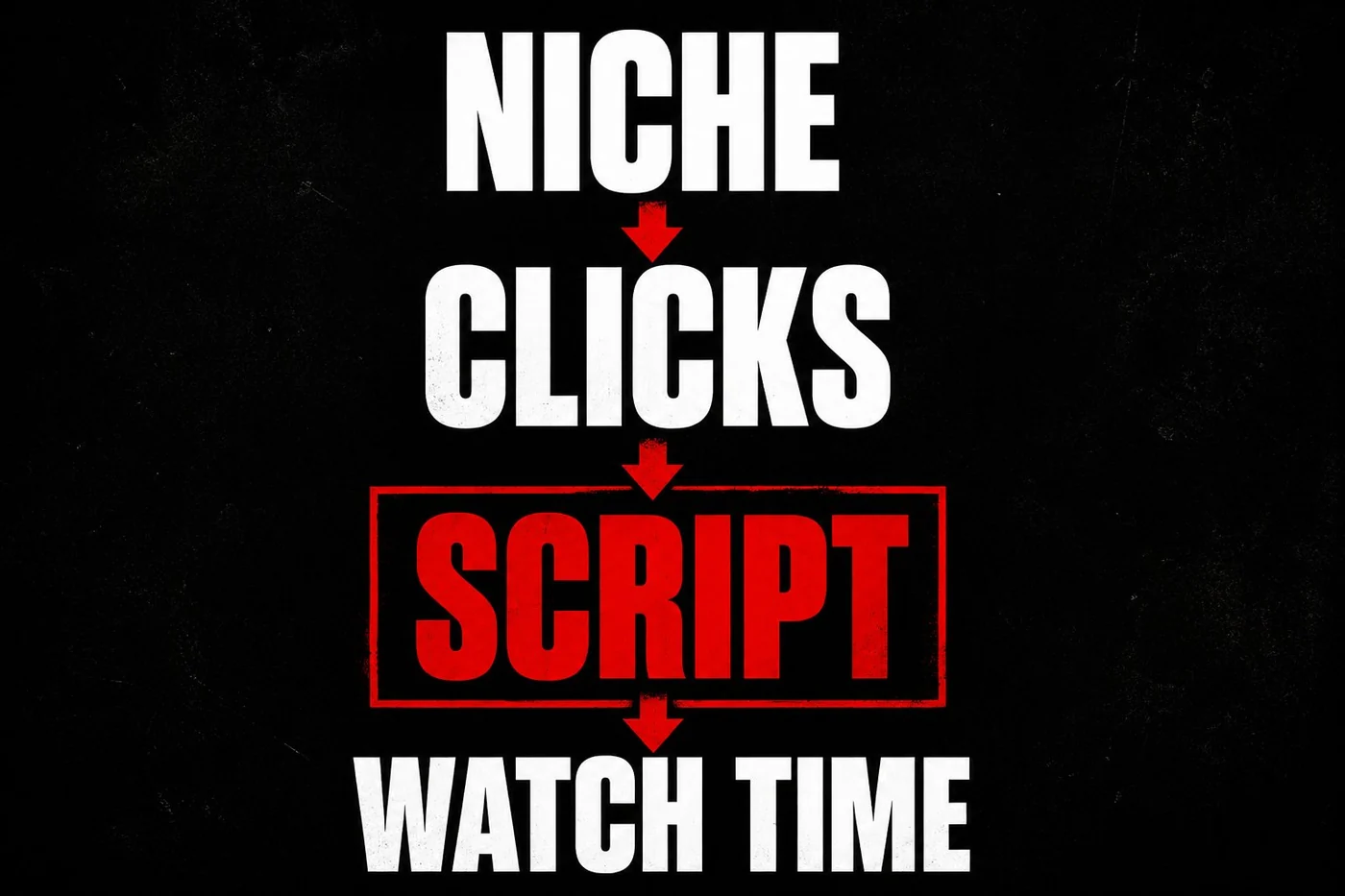
the niche you're in determines who clicks. the script you write determines whether they stay. and youtube's algorithm rewards one thing above everything else: watch time. watch time is a retention problem, not a niche problem.
i've seen this exact pattern play out enough times that it's boring now:
- creator in finance niche gets 38% retention at the 30-second mark
- creator switches to true crime, gets 41% retention at the 30-second mark
- creator switches to health and wellness, gets 39% retention
three niches. one problem. the script structure never changed.
what "small channel hell" actually is
small channel hell is not a view count problem.
it's a retention architecture problem that youtube's distribution system is correctly penalising.
here's how youtube actually distributes content. the platform tests every new video by pushing it to a small seed audience. it measures how long those viewers watch, how many click away in the first 30 seconds, how many make it to the midroll, how many watch to the end.
if retention is strong, the algorithm widens distribution. if it's weak, the video gets buried regardless of how good the thumbnail was, how well-researched the topic was, or how hot the niche is.
so when your video gets 400 views and stops, that's not the algorithm being unfair. that's the algorithm reading your retention data and making a rational decision.
your viewers are clicking away at the 40-second mark. the system saw it. the system responded correctly.
and the reason they're clicking away at the 40-second mark is almost never the niche. it's the delay disease: failing to confirm in the first 15 seconds that this video is exactly what they clicked for.
the niche that's "too saturated" is a myth
i get this objection constantly.
"the true crime niche is too saturated." "finance is dominated by big channels." "history has been done to death."
joey hit 863,000 views from a single script in a niche that had thousands of competing channels. SoloGains hit 100,116 views in a category full of established players.
neither of those results came from finding an untapped niche. they came from building a script with retention architecture that the competing channels weren't using.
the "too saturated" belief assumes that distribution is zero-sum. that there's a fixed amount of views in any given niche and the big channels have claimed all of them.
youtube doesn't work that way. distribution is driven by performance relative to audience expectation, not by competitive landscape.
a video that holds 70% retention in a saturated niche will get distributed over a video that holds 40% retention in an untapped niche. every time. the algorithm doesn't care how many other channels cover the same topic. it cares which video viewers are actually watching.
the channel that proved it
one creator came to me after spending eight months trying to grow a finance channel.
he'd tried three sub-niches within finance. stock trading, passive income, personal budgeting. none of them broke past 2,000 views. he was convinced the personal budgeting niche was dead and was about to pivot to AI tools.
i looked at his scripts. the problem was obvious in the first paragraph of every one.
- every video opened with 20-30 seconds of "hey guys, welcome back, today we're going to be covering..."
- every hook was framed around the topic rather than the viewer's situation
- every section transitioned cleanly with no curiosity gap left open
the retention graph looked like a cliff. 45% of viewers gone by second 30.
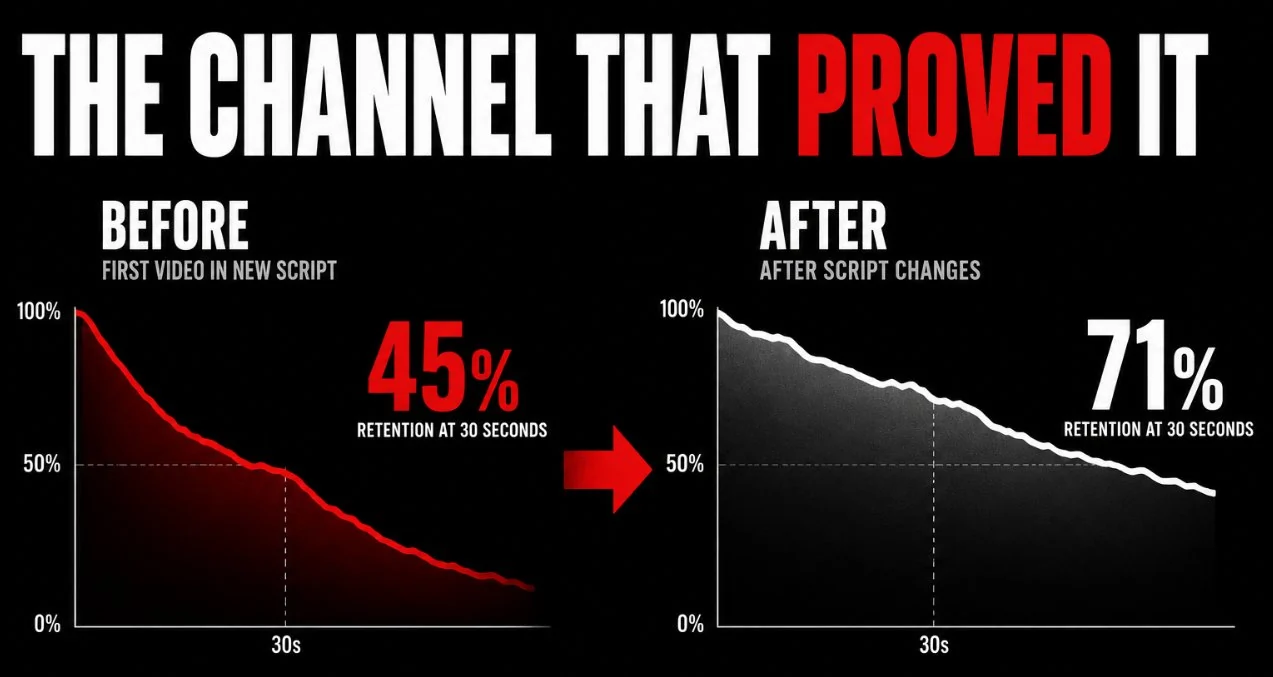
we fixed the script architecture. kept the same niche. same production setup. same upload schedule.
his next video held 71% retention at the 30-second mark. the video after that got recommended alongside three channels with 500K+ subscribers.
the niche was never dead. the script was.
what's actually killing your retention
retention breaks down at three specific points. if you're stuck in small channel hell, you're losing viewers at one or more of these:
the 0-30 second window. this is the trust check. the viewer clicked on your thumbnail expecting a specific experience. if your first 15 seconds don't confirm that experience, they leave. most faceless creators spend these seconds saying hello and setting up the topic. the viewer has already left.
the fix: your first sentence needs to name the viewer's situation, not your topic. "if you're a faceless creator getting 400 views a video and can't figure out why your niche isn't working" is more powerful than "today i'm going to break down why niches don't matter."
the 3-8 minute window. this is the payoff void. the creator delivered the first piece of value and then moved to the next section without opening a new curiosity gap. there's a 30-60 second window where the viewer is in a state of completion. completed = no reason to stay.
the fix: within 10 seconds of every mini payoff, you need a transition that makes leaving feel unfinished. "but that's the small version of this problem. the real one is what happens to your channel two months in and nobody talks about it."
the final 2 minutes. this is the grand payoff betrayal. your title made a promise. if the payoff arrives too late, 80% of your viewers have already left and never got the answer they clicked for.
the fix: foreshadow the grand payoff three times across the video. once in the hook, once at the 3-minute mark, once at the 8-minute mark. each time you remind the viewer: this is coming, stay with me.
the thing nobody wants to hear
i know what you're thinking right now.
"but i know creators in dead niches who can't grow. isn't niche selection part of it?"
yes. niche matters. RPM matters. market size matters.
but those variables only become meaningful once your retention is working.
a channel with 70% retention at the 30-second mark in a low-RPM niche earns more per 1,000 views than a channel with 35% retention in a high-RPM niche, because it's getting 3-4x more views for the same upload. the algorithm distributes based on watch time, not topic category.
fix the retention first. then optimise the niche.
the creator who spends six months niche-pivoting with broken script architecture is building in the wrong order. they're changing the walls while the foundation has a crack.
your scripts need a retention system. not a new topic.
if you want to see what that looks like in practice, the newsletter at fyreinteractive.co/newsletter breaks down a different retention principle every week directly from 8,000+ scripts of real data.
and if you want the full system, 22 skill files trained on those 8,000+ scripts, built to produce scripts that hold retention across 50+ niches, grab FacelessOS at fyreinteractive.co/facelessos
if you want to grab FacelessOS and stop losing viewers at the 30-second mark, go to fyreinteractive.co/facelessos
(8,000+ scripts. $5M+ generated for clients. 22 skill files trained on pattern data across 50+ niches.)
haris
keep reading
Put this into every script you write
FacelessOS is 22 skill files built from 8,000+ scripts across 50+ niches. It works with any AI. 300+ creators are using it. $699 one-time for Files, $1,199 for FacelessOS+. No subscription.
Get FacelessOS