three years ago i walked into a niche i'd never heard of and wrote 40 scripts in 30 days.
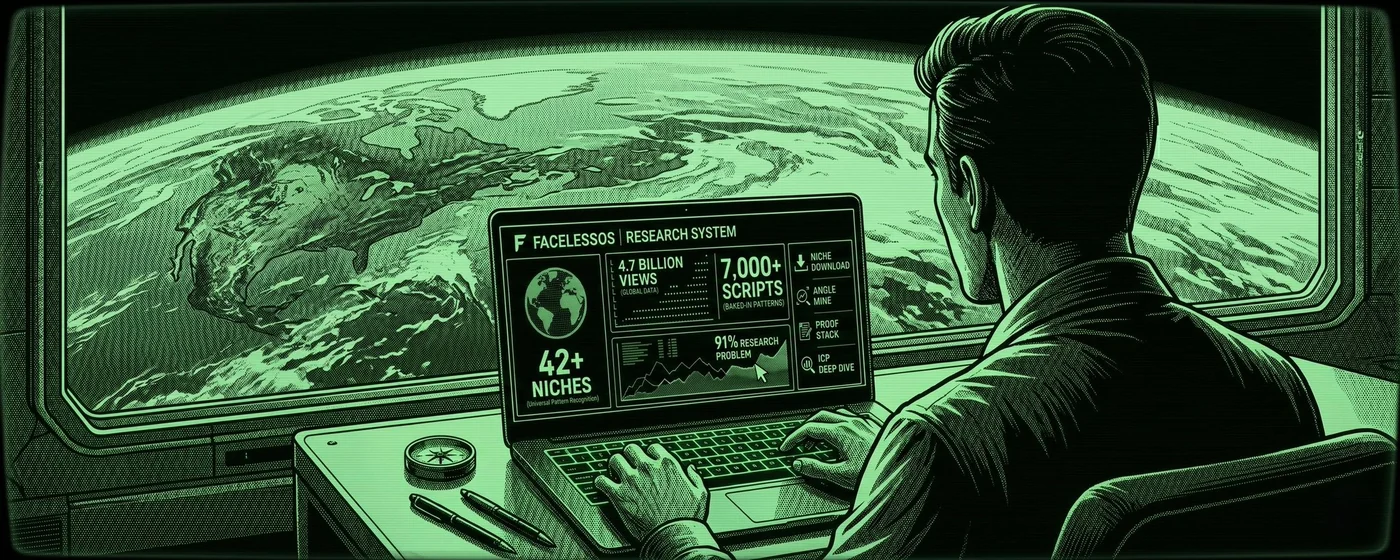
yep. this is the research system i created for myself that made it possible.
i knew nothing about hydraulic presses, CNC machines, or injection molding. i couldn't tell you the difference between a lathe and a drill press... and this guy wanted 40 scripts by end of month.
most scriptwriters would've said no. i said yes, panicked for about 45 minutes, then sat down and built a research process that i've now used across 50+ niches and 8,000+ scripts.
that process is what separates a scriptwriter who can handle one niche from one who can handle any niche and it's what separates a faceless channel that runs out of ideas at video 15 from one that's still producing bangers at video 150.
91% of the people i talk to say research is their biggest problem.
not the writing or editing itself. research.
finding stories, data, angles, proof. the raw material that makes a script worth watching.
so here's the full system. not one trick, the whole thing.
step 1: the niche download (first 2 hours)
before i write a single word, i spend 2 hours downloading everything about the niche into my brain. no casual browsing.
structured fucking immersion.
here's what that looks like:
→ find the top 10 channels in the niche. not by subscriber count. by view-to-sub ratio. a channel with 50K subs averaging 500K views per video is more useful than a channel with 2M subs averaging 100K views.
→ watch their top 5 videos each. not for entertainment.
i'm logging: what hooks they use, what structure their scripts follow, where the retention dips are, what topics get outsized views vs their average.
→ read the comments. every single one on their top videos.
this is where the audience tells you what they actually want. "i wish someone would cover..." and "nobody talks about..." are gold.
→ find the subreddit. every niche has one.
sort by top of all time, then top of the past month. the gap between those two lists tells you what's trending vs what's evergreen.
this isn't optional. this is the foundation.
skip this and everything downstream is guesswork.
step 2: the angle mine
this is where most creators stop. they find a topic. they write about it. done.
that's how you end up with the same video as 50 other channels.
angle mining is different. you take one topic and find 5-10 completely different ways to approach it.
example. topic: "why people go broke."
→ angle 1: the psychology of spending (behavioral economics lens) → angle 2: the 3 purchases that bankrupted 10,000 people (data-driven) → angle 3: a billionaire who went broke in 18 months (story-driven) → angle 4: the industry designed to keep you poor (conspiracy/systemic lens) → angle 5: i went broke at 22. here's what nobody told me. (personal/confession)
same topic.
five completely different scripts.
five completely different audiences.
five completely different retention curves.
the angle IS the script.
two creators covering the same topic with different angles will get completely different results, and the one with the better angle wins every time, even if their editing is worse.
i learned this after writing scripts in 50+ niches.
the research process isn't finding what to write about.
you're looking for the "HOW" to write about it.
step 3: the proof stack
here's where amateur scripts die.
they make claims with no evidence. "studies show..." (which studies?) "experts say..." (which experts?) "research suggests..." (whose research?)
every claim in a script needs a proof stack.
three layers:
→ layer 1: the specific data point.
not "millions of people." actual numbers.
"$4.7 billion in views deleted." "16 channels terminated." "38% of new monetized channels are faceless."
specific numbers are more believable AND more interesting.
→ layer 2: the source.
where did this number come from? a study? a news article? a platform report? your own data?
name it.
→ layer 3: the story behind the number.
numbers without context are forgettable.
"youtube deleted 4.7 billion views" is a fact.
"youtube deleted 4.7 billion views, and one of those channels was making an estimated $2M per year from AI-generated dragon ball content" is a story.
most scripts have layer 1 at best. the ones that hold retention have all three.
this is the exact research depth built into every FacelessOS script. 22 skill files. 8,000+ scripts of pattern recognition baked into the system.
$699 for the files, $1,199 for FacelessOS+ with lifetime Private Discord access. → fyreinteractive.co/facelessos
step 4: the ICP dig
ICP = ideal customer profile. but for scripts, it's ideal VIEWER profile.
before i write a script i need to know EXACTLY who's watching.
not "people interested in finance."
that's useless.
i mean:
→ what do they already believe about this topic? → what have they already watched on this topic? → what's the thing they THINK is true that i'm about to challenge? → what specific problem are they trying to solve by clicking on this video?
DuckDuckGo is my secret weapon here.
Google filters results based on your location, search history, and profile. DuckDuckGo shows you what the AVERAGE person sees. that's your viewer.
search your topic on DuckDuckGo. the first page of results tells you what your audience already knows. your script needs to either go deeper than those results or directly contradict them.
if your script says the same thing as the first page of DuckDuckGo results, you've written a script nobody needs.
step 5: the story bank
every niche has stories, and 99% of creators don't know where to find them.
here's where i pull from, in order of quality:
→ reddit threads (real people, real emotions, specific details).
the best scripts i've ever written started with a reddit comment that made me stop scrolling.
→ quora answers (deeper, more detailed, often from experts).
a single quora answer from someone who worked in the industry for 20 years is worth more than 10 blog posts.
→ court documents and public records (for true crime, business, legal niches).
these are primary sources. nobody else is reading them. that's your advantage.
→ academic papers (for psychology, science, health).
not the abstract. read the methodology section.
that's where the interesting details are.
"researchers put 49 people in a room and asked them to lie to strangers" is a HELLA MORE interesting than "a study on deception found that..."
→ news archives (not today's news. news from 5, 10, 20 years ago).
old news that's been forgotten is better content than breaking news that everyone's covering.
→ books (for the contrarian take the internet hasn't discovered yet).
find a book that disagrees with the conventional wisdom in your niche. that's your next video.
one FacelessOS member, Joey Sergio, hit 863,041 views on a single video.
the script worked because the research was deep enough that viewers couldn't get this information anywhere else.
not the writing style. focus on the research depth.
step 6: niche-specific patterns
this is the part nobody teaches because nobody has the data.
i've written scripts in 50+ niches. and the research process is NOT the same across all of them.
→ true crime: the story IS the research.
you need primary sources, timeline accuracy, and details that aren't on the wikipedia page. viewers in this niche will fact-check you in the comments. if you're wrong about one date, you lose credibility on everything.
→ finance: the data IS the research.
viewers want specific numbers, specific timeframes, specific comparisons. "the S&P 500 returned 26.3% in 2023" hits different than "the stock market did well."
→ psychology: the study IS the research.
you need the actual study name, the sample size, and the specific finding. "a Stanford study" is not enough. "a 1971 Stanford study where Philip Zimbardo put 24 students in a fake prison" is a story.
→ history: the detail IS the research.
the small, weird, specific detail that makes a historical event feel real. "napoleon was short" is boring and wrong. "napoleon's autopsy revealed his penis was reportedly one inch long" is... memorable.
→ health: the mechanism IS the research.
viewers don't just want "this food is bad for you." they want to know WHY. the biochemistry. the pathway. the specific mechanism that makes it harmful.
every niche has its own version of what "good research" means. if you're applying the same research depth and focus to every niche, you're getting mediocre results in all of them.
all of these niche-specific patterns are encoded into FacelessOS. the system adapts its research prompts, proof structures, and script frameworks based on which niche you're writing for.
50+ niches worth of pattern data, not generic templates. → fyreinteractive.co/facelessos
step 7: the 20-script test
here's what i tell every FacelessOS member on day one.
don't write one script and judge whether it works. write 20.
→ scripts 1-5: you're learning the niche. these will be your weakest. publish them anyway.
→ scripts 6-10: you're finding your voice in the niche. one of these will outperform.
→ scripts 11-15: you understand the audience now. you know what they click, what they watch, what they skip.
→ scripts 16-20: this is where the real data starts. you have enough videos to see patterns. which topics, which angles, which structures work in YOUR version of this niche.
Ed started two faceless channels on January 20, 2026. by February, he'd made $13,160.43 across both channels. by month two, another $33,900. by the end of two months, over $50,000 total.
he didn't get lucky on one video. he ran the 20-script process and let the data tell him what to double down on.
Niflick hit 70,700 watch hours and 7,200 new subscribers in a single 28-day period. 65,900 more watch hours than usual. that's research compounding.
the research process isn't going to be for just one video.
you need to be building a machine that produces scripts worth watching.
every script teaches you something about the niche.
by script 20, you know more about what works in your niche than 99% of creators who've been doing it for a year.
why this matters more in 2026
youtube terminated 16 channels in january 2026. 4.7 billion views deleted.
the channels that got hit had one thing in common: no original research.
every script was surface-level information that could've been scraped from the first page of google.
youtube's new standard is "inauthentic content." and content built on zero original research is, by definition, inauthentic.
the channels surviving this wave are the ones where someone actually sat down, dug into the niche, found information that wasn't easily available, and built a script around specific stories and data points that couldn't be replicated by swapping in a different topic.
that's what research does. it makes your content irreplaceable.
and irreplaceable content is the only kind youtube is letting on the platform in 2026.
don't fade the method 🥷
get FacelessOS → fyreinteractive.co/facelessos
keep reading
Put this into every script you write
FacelessOS is 22 skill files built from 8,000+ scripts across 50+ niches. It works with any AI. 300+ creators are using it. $699 one-time for Files, $1,199 for FacelessOS+. No subscription.
Get FacelessOS