
i want to talk about something that explains why creators with amazing content and high engagement are making zero money from it.
most faceless creators think the answer is better content. that's what every guru tells them. improve your production quality. post more consistently. create more value.
and so they do all of that. their content gets better. their engagement improves. their retention graphs look solid.
and still no revenue. no business inquiries. no conversions.
because the content was never the problem. the positioning was.
the invisible problem
the creators who print money on youtube aren't necessarily making the best content.
they're the ones who've positioned themselves differently in their market.
i see this pattern constantly across the scripts i write and the channels i audit. incredibly talented creators producing scripts with strong retention, solid hooks, well-paced middle sections. their content is genuinely good. and the business results are zero.
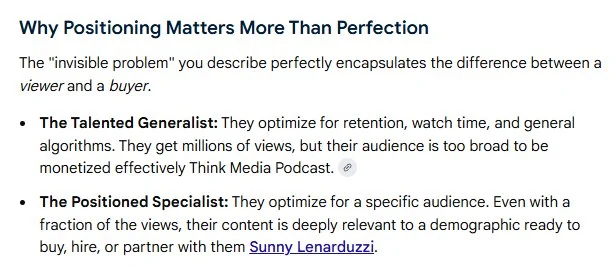
meanwhile, creators with objectively average content are booking clients, selling products, and building revenue streams that compound.
the difference isn't skill. it isn't production value. it isn't even retention. the difference is that one creator is positioned as the obvious choice for a specific audience, and the other is positioned as "another channel covering this topic."
this distinction matters more for your revenue than any scriptwriting framework i could teach you. and most creators have never thought about it once.
trap 1: the vanilla brand problem
this is when your personality and unique perspective are completely stripped from your positioning.
most creators think professional means generic. they avoid strong opinions. they avoid controversial takes. they avoid anything that might turn someone off. they present themselves as the safe, predictable choice.
here's what happens: when you try to appeal to everyone, you appeal to no one. your audience can't connect with you because there's nothing distinctive to connect with.
the fix: inject your unique perspective into your positioning. if you believe the faceless youtube industry is doing scriptwriting wrong, say it. if you think most AI content is slop, own that position. if you have a contrarian approach to retention that goes against what the gurus teach, lead with it.
instead of "i help faceless creators grow their channels," try "i help faceless creators who are sick of getting 400 views because their scripts were written by an AI with no editorial direction."
strong positioning repels some people and attracts others intensely. weak positioning attracts no one. your goal isn't to be liked by everyone. it's to be the only choice for your specific audience.
trap 2: the clone problem
this is when you're using the exact same language and promises as every other creator in your space.
walk into the faceless youtube niche on twitter and everyone sounds identical. "i help creators grow their channels." "i write scripts that get views." "i teach faceless youtube."

when you use the same language as everyone else, you become background noise. your audience can't distinguish you from the 500 other people saying the same thing.
the fix isn't niching down your audience. it's niching down your message.
instead of "i help creators grow," try "i help faceless creators who've tried 3 niches in 6 months and still can't break 2,000 views because the problem was never the niche."
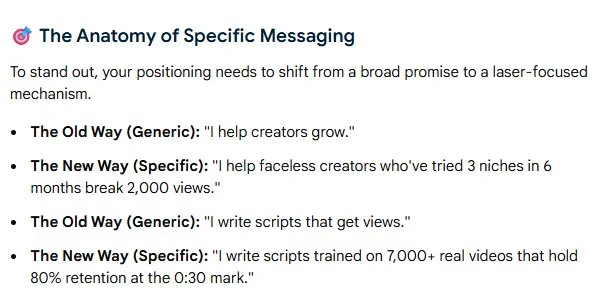
instead of "i write scripts that get views," try "i write scripts trained on 8,000+ real videos that hold 80%+ retention at the 0:30 mark because generic AI prompts produce the flat scripts youtube's classifier is trained to bury."
you're not changing who you serve. you're getting surgical about the exact situation and problem you solve. specificity creates connection. when someone hears their exact situation described, they think: "this person gets me." generic positioning creates no emotional response. specific positioning creates immediate recognition.
trap 3: the credibility gap
this is when there's a disconnect between what you're promising and what people believe you can deliver.
you could have the best system in the world. if people don't believe you can deliver on it, your positioning fails.
this happens when your visible authority doesn't match your claims. if you're promising results but have no visible proof of your own journey, that's a credibility gap. if you're teaching scriptwriting but your own content doesn't demonstrate the principles you're selling, that's a credibility gap.
the fix is what i call authority stacking:
- share client results with specific numbers, not vague testimonials
- show your own transformation journey with honesty, not polish
- demonstrate expertise through case studies and real retention data
- display proof from multiple angles, not just one highlight reel
every promise in your positioning needs visible evidence behind it. people need to believe before they'll engage. your positioning isn't about what you promise. it's about proving you can deliver.
if you want to see how i apply these positioning principles to scriptwriting specifically, i break that down in the weekly newsletter at fyreinteractive.co/newsletter.
the 7 steps to standing out
fixing the three traps above requires a systematic approach, not a one-time rebrand. here are the seven steps i've refined across building my own positioning from $30/script freelancer to a multi-six-figure business.
step 1: define what you're against, not what you're for.
"i help creators write better scripts" is boring. "i'm against the AI slop epidemic that's getting thousands of faceless channels demonetised while the gurus tell you to just keep uploading" is a position. the things you stand against define you faster than the things you stand for.
step 2: name your method.
generic expertise is forgettable. named systems are memorable. i don't just "write scripts." i run FacelessOS: 22 skill files trained on 8,000+ real scripts. the name creates a container. the container creates perceived value. and the specificity of "22 skill files trained on 8,000+ scripts" makes it impossible to confuse with anyone else's approach.
step 3: lead with your messiest credential.
my first script paid $30. i failed A levels twice. i dropped out of university when my family went broke. these aren't embarrassing backstories. they're proof that i can handle transformation at a visceral level. the clients who pay premium rates aren't looking for perfection. they're looking for proof that someone who started where they are figured it out.
step 4: create a language your audience speaks.
the delay disease. the context dump. the payoff void. the grand payoff betrayal. these names didn't exist before i coined them. now they're the vocabulary my audience uses to diagnose their own problems. when you create the language, you own the conversation.
step 5: show, don't claim.
"i'm the best scriptwriter in the faceless youtube space" is a claim. "joey hit 863,000 views from one script. RK monetised in 3.5 hours. ed made $50K+ in 2 months from channels started from zero" is proof. stop announcing your authority. demonstrate it through the results your system produces for other people.
step 6: position yourself as the guide, not the guru.
the shift from teaching to storytelling changed my entire business. when you teach, people consume your content and feel like they learned something. when you tell stories about real transformations, people consume your content and feel like they need more from you. teaching creates an audience of free value seekers. storytelling creates buyers.
step 7: make your content do double duty.
every piece of content you create should simultaneously deliver value AND position your system as the mechanism behind the result. when i break down why a script held 70%+ retention, i'm delivering genuine insight while demonstrating that my framework produced that outcome. the content isn't separate from the positioning. the content IS the positioning.
the compound effect of positioning
fixing these seven steps doesn't produce overnight results. it produces compound results.
month one: your content starts attracting a more specific audience. month two: that audience starts recognising your language and your method. month three: people start referring to your concepts by the names you gave them. month six: you're no longer competing in a crowded market. you're the only person in your specific positioning.
that's the trajectory i experienced. and it's the same trajectory i've watched my clients experience when they apply the same principles to their channels.
warner aarts made $35K in 7 days from a newsletter using positioning principles drawn from the same retention psychology i teach for scripts. my brother hamza went from criminal lawyer to premium scriptwriter by leading with his transformation story rather than his credentials. rohan went from broke university student to $1,000+/month by positioning himself as someone who understands the faceless creator's struggle because he lived it.
the positioning came first. the revenue followed.
if you want the full scriptwriting system that produces the kind of results you can stack into authority proof, 22 skill files trained on 8,000+ real scripts, grab FacelessOS at fyreinteractive.co/facelessos
if you want to grab FacelessOS and start producing scripts that build your authority while they build your client's revenue, go to fyreinteractive.co/facelessos
(8,000+ scripts. $5M+ generated for clients. 22 skill files trained on pattern data across 50+ niches.)
haris
keep reading
Put this into every script you write
FacelessOS is 22 skill files built from 8,000+ scripts across 50+ niches. It works with any AI. 300+ creators are using it. $699 one-time for Files, $1,199 for FacelessOS+. No subscription.
Get FacelessOS