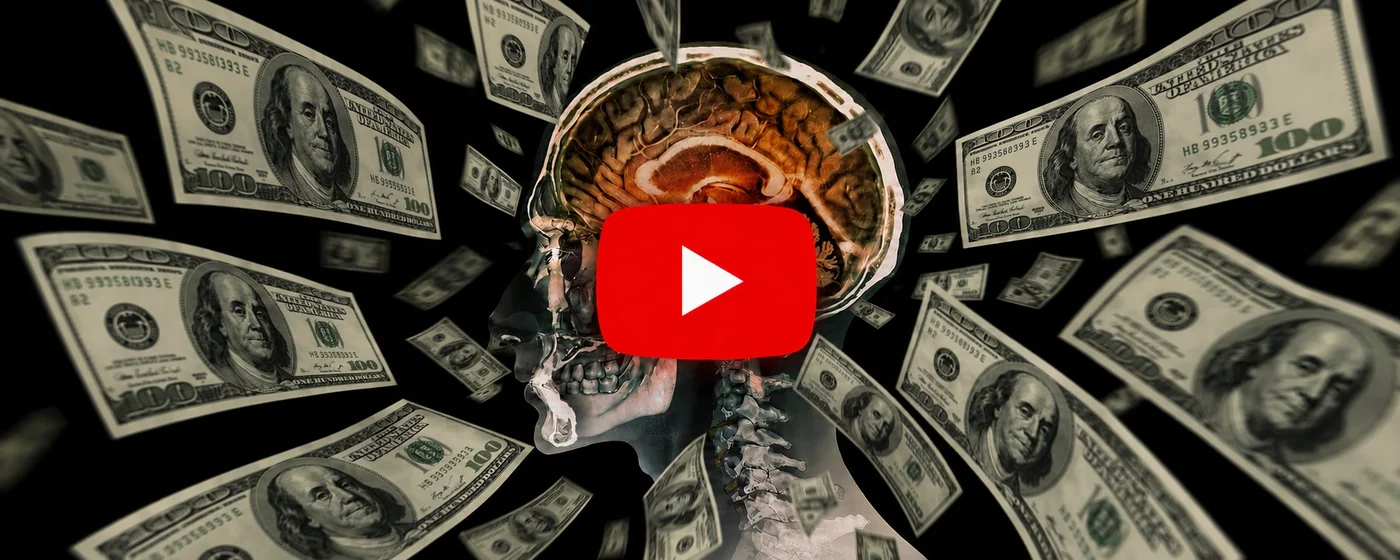
i've been obsessed with one question for three years.
why do some faceless videos with zero personality on screen, zero face, zero body language, hold attention better than videos from creators who've been on camera for a decade?
after writing 8,000+ scripts across 50+ niches, i think i've figured it out. and the answer goes way deeper than "good hooks" and "retention tricks." it goes into fundamental human psychology. stuff that was figured out thousands of years before youtube existed.
the parasocial vacuum effect
in traditional youtube, creators build parasocial relationships. the viewer feels like they know the creator personally. faceless channels can't do this. there's no face to connect with.
but that absence creates something more powerful. it creates what psychologists call a "projection surface." when there's no face on screen, the viewer's brain projects its own internal narrator onto the content. the faceless voice becomes their own internal monologue talking to them.
freud called this "transference." the unconscious redirection of feelings from one entity to another. in faceless content, the viewer transfers their own authority onto the narrator. they feel like they're arriving at the insight themselves.
this is why faceless educational content often feels more trustworthy than face-to-camera content. the viewer absorbs the message without ever stopping to judge the messenger. but this only works if the script maintains what i call "seamless authority." the moment the writing feels uncertain, generic, or unfocused, the projection breaks. the viewer suddenly becomes aware that they're listening to a stranger, and the trust evaporates instantly.
jung's archetype activation
carl jung identified universal archetypes that exist in every human's unconscious. the hero, the shadow, the trickster, the sage. the faceless channels that print the most money are unconsciously activating specific archetypes through their scripts.
documentary channels activate the sage archetype. the all-knowing narrator who reveals hidden truths. true crime channels activate the shadow archetype. they explore the dark, repressed aspects of human nature that people are fascinated by but can't openly discuss. the viewer feels a strange permission to explore these topics because there's no face judging them for being interested. conspiracy and mystery channels activate the trickster archetype. the idea that reality isn't what it seems. this triggers what psychologists call "pattern recognition hunger" - the deep human need to find order in chaos.
the channels making the most money aren't just picking trending topics. they're tapping into archetypes that trigger deep, unconscious engagement.
the information gap theory (loewenstein)
george loewenstein's information gap theory from 1994 explains something critical about faceless content. when we perceive a gap between what we know and what we want to know, we experience a feeling that's psychologically similar to physical pain. we need to close that gap. it feels uncomfortable to leave it open.
this is the science behind curiosity gaps. and it's why they're the single most important structural element in faceless youtube scripts.
but here's the part that's easy to get wrong. they open one curiosity gap at the beginning and try to sustain it for 10 minutes. the psychological discomfort fades over time. your brain adapts. the channels that print chain multiple gaps. they close one gap (providing relief) and immediately open another (creating new discomfort). this creates a cycle of tension and release that the viewer's brain becomes addicted to.
i call this setup-tension-resolution looping. it's the reason some faceless videos maintain 60-70% retention for 15+ minutes while others bleed viewers after minute 2.
the zeigarnik effect
bluma zeigarnik discovered in the 1920s that people remember uncompleted tasks better than completed ones. the brain allocates more cognitive resources to things that are left unfinished.
this is why foreshadowing is so powerful in faceless content. when you say in your hook "and what happened next changed everything we know about this case" and then don't reveal what happened for another 8 minutes, the viewer's brain literally cannot let go of that unresolved thread.
the channels making the most money foreshadow their grand payoff at least three times throughout the video. once in the hook, once around minute 3, once around minute 8. each mention re-activates the zeigarnik effect and refreshes the viewer's cognitive commitment to watching.
the mere exposure effect and the faceless advantage
psychologist robert zajonc demonstrated that people develop preferences for things simply because they're familiar with them. in face-to-camera content, the mere exposure effect is tied to the creator's face and personality. when that creator isn't available, the content stops.
in faceless content, the mere exposure effect attaches to the format, the niche, and the production style. the viewer gets loyal to an experience instead of a person. this makes faceless channels more resilient and also makes the channel a sellable asset - something face-to-camera creators can never truly build.
the contrast principle (cialdini)
robert cialdini's contrast principle states that we perceive things differently based on what was presented immediately before.
the best faceless channels use this constantly. in a documentary about a historical event, they'll show the mundane reality first, then reveal the shocking truth. "everyone thought this was just a routine expedition. what they found 200 feet below the surface changed everything." the shock lands harder because of the contrast. this is a psychological mechanism that amplifies the emotional impact of every revelation. and it's built into every script framework i use.
the faceless channels that print are activating specific psychological mechanisms that have been studied and documented for over a century. the projection surface (freud). jungian archetype activation. the information gap theory (loewenstein). the zeigarnik effect. the mere exposure effect (zajonc). the contrast principle (cialdini).
almost nobody making these videos has heard of any of this. the creators making $10k, $50k, $100k per month from faceless channels are applying these principles systematically. whether they know it or not.
i figured this out the hard way. 8,000+ scripts. three years. thousands of hours of testing. every framework i use is built on these psychological principles, adapted for the attention economy of 2026.
300+ creators. zero churn. because the psychology works.
• haris
keep reading
Put this into every script you write
FacelessOS is 22 skill files built from 8,000+ scripts across 50+ niches. It works with any AI. 300+ creators are using it. $699 one-time for Files, $1,199 for FacelessOS+. No subscription.
Get FacelessOS