
a quick note before we get into this: everything below is real. these are the same psychological mechanics that casinos use to keep people gambling, that slot machine designers use to keep people pulling the handle, that social media platforms use to keep you scrolling at midnight when you planned to sleep at 10. they work because they bypass conscious decision-making and operate directly on the primitive parts of the brain. i'm sharing this because i believe in youtube content that genuinely educates, entertains, and improves people's lives. use these principles on channels that add real value to the world. the moment you deploy them on content that spreads misinformation, exploits vulnerable people, or actively causes harm, you've crossed a line. don't cross it.
now, let's talk about what's actually happening when a video holds 70% retention through 10 minutes.
most faceless creators look at a retention graph that looks like a cliff and assume the problem is the thumbnail. or the niche. or the editing. these are the variables they can see and measure easily, so they become the focus of the audit.
the variable they're not looking at is the script.
i've written 8,000+ scripts across 50+ niches and generated $5M+ in revenue for clients and myself through youtube. and after reviewing hundreds of retention graphs against the scripts that produced them, the pattern is clear: the editing is the skin. the voiceover is the voice. the script is the skeleton. if the skeleton has the wrong structure, nothing on top of it saves you.
but what makes a script skeleton "right" has nothing to do with grammar, style, or even information quality. it has everything to do with five psychological mechanisms that the human brain responds to involuntarily.
these aren't creative tricks. they're biology. and once you understand them, you'll see them in every video that holds you past the first two minutes.
the caveman brain problem
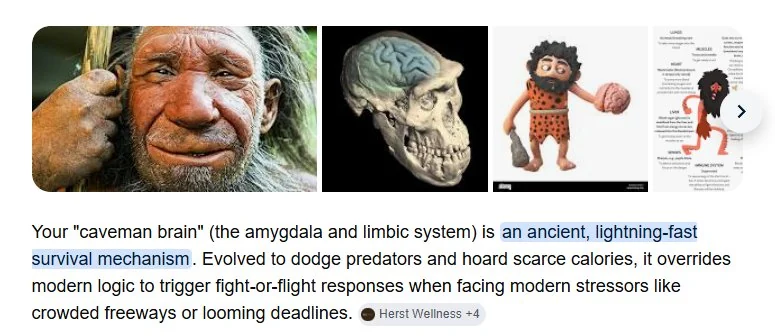
ere's what content creators miss when they think about "engaging content."
the part of the human brain that makes the stay-or-leave decision on a youtube video is not the rational, analytical prefrontal cortex. it's the older, faster, more primitive system - the one built to detect threats, track social dynamics, and close unresolved loops before the brain can rest.
this system does not respond to good information. it responds to specific triggers that were developed to keep early humans alive in an environment where missing a threat meant death.
casinos figured this out long before youtube existed. every slot machine is engineered around these triggers: variable reward schedules to prevent habituation, near-miss mechanics to keep the loop open, ambient sensory stimulation to maintain arousal, the illusion of agency to sustain investment. none of this makes gambling more enjoyable in a conscious sense. it makes it harder to stop at a subconscious one.
your script needs to operate on the same mechanics. not to exploit your viewer. to hold their attention long enough to deliver the genuine value you've actually created for them.
principle 1: hook confirmation (the trust trigger)
the caveman brain runs a trust check in the first 8 seconds of every video.
this isn't conscious. it's automatic. the viewer clicked on a thumbnail that made a specific visual promise. your opening 8 seconds are evaluated against that promise instantly. if the audio-visual experience confirms the promise, the trust check passes and the viewer relaxes into watching. if it doesn't, a warning fires: this might not be the right video.
that warning is one click away from executing.
creators fail this check by treating the hook as a creative introduction rather than a confirmation. they open with atmosphere, with story setup, with a statement about what the video is going to cover. all of this delays confirmation. and delay triggers the warning.
the fix is to state the promise explicitly, frame it around the viewer's situation rather than your content, and crack open the first curiosity gap - all inside the first 20 words.
"if you're a faceless creator stuck under 50,000 views and you can't figure out why your editing isn't fixing it - i'm going to show you why your script is the problem, and it's going to take about 2 minutes to make it obvious."
that's hook confirmation. topic confirmed. viewer's situation named. gap opened. trust check passed.
the $14.4K video that came from 225 views? the hook ran this check perfectly. 85% of viewers who started the video were still watching at the 0:30 mark. that number doesn't come from production quality. it comes from passing the trust check in the first 8 seconds.
principle 2: the curiosity gap (the loop mechanism)
in 1994, a behavioural economist named george loewenstein published research on what creates curiosity. his information gap theory: curiosity is triggered when someone perceives a gap between what they know and what they want to know. the brain experiences this gap as uncomfortable. it registers an incomplete loop. and the drive to close that loop overrides voluntary attention decisions.
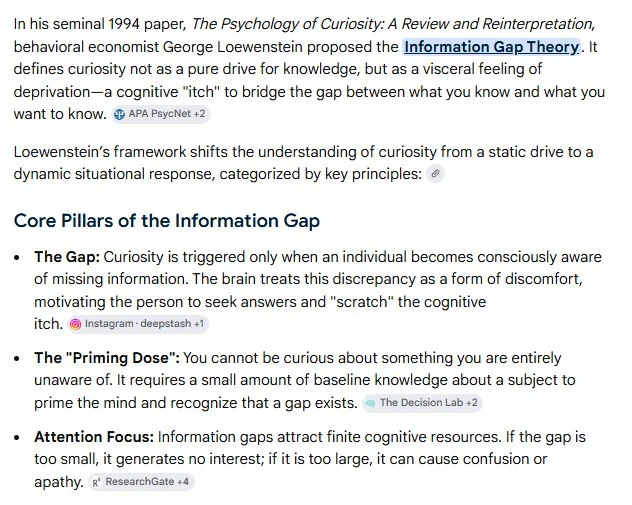
in plain language: an open question isn't something you choose to think about, it's something your brain makes you think about until it's resolved.
slot machine designers know this. the near-miss isn't an accident. when the machine shows two jackpot symbols and one off-symbol, it creates the sensation of almost-having-something that needs to close. the loop opened. the loop needs to close. so you pull again.
scripts work on the same mechanic. but the sophistication is in the chaining.
a single open loop is good. chained open loops are addictive.
chaining means: before the current loop closes, you open the next one. the viewer resolves one gap and immediately finds themselves mid-sentence in a new one. the moment of resolution and the moment of new opening overlap. there is no clean moment of completion where the viewer can make a rational decision to stop watching.
this is why the best scripts feel like you can't stop watching rather than that you're choosing to continue. you're not choosing. the loop is keeping you.
i built a script for a true crime channel using a 7-loop chain across an 8-minute video. each loop was set up before the previous one resolved. the average retention was 68%. viewers who clicked on a topic they'd already seen covered dozens of times on other channels stayed because the structure made leaving feel incomplete.
principle 3: input bias (the investment trap)
this one is counterintuitive and it's the reason that scripts which work the viewer harder often outperform scripts that hand everything over easily.
input bias is a cognitive bias where people assign higher value to things they've invested effort to understand. it's the same psychological mechanism behind the IKEA effect: a table you built yourself feels more valuable than an identical table you bought assembled, because you put work into it.
when your script forces the viewer to hold a framework in their head while you layer new information on top of it - to actively process rather than passively receive - they become invested in the content in a way that passive viewers don't. the mental work makes the payoff feel earned. earned payoffs are more satisfying. more satisfying content gets watched through to the end.
the dark side: this is deployable on purpose.
you can structure a script to require cognitive investment at specific intervals. not by making the content confusing, but by presenting a problem the viewer didn't know they had, then introducing a framework that explains the problem without yet solving it, then asking them to hold that framework while you demonstrate it across multiple scenarios, then delivering the solution.
by the time the solution arrives, the viewer has done real intellectual work. the resolution feels like the completion of their effort, not just the delivery of your information.
this is the same mechanic that makes a mystery novel where you've been collecting clues feel more satisfying than one where the detective just explains the solution in chapter one.
principle 4: pacing dynamics (the pattern violation engine)
the human brain habituates to constant stimulation. present the same signal at the same rate for long enough and the brain starts to predict it. once it predicts it, it allocates less attention to it. less attention means lower retention.
this is why content that's technically excellent - genuinely valuable, well-researched, clearly delivered - can still bleed viewers after the first two minutes. the brain calibrated. it knows what's coming. so it stops paying full attention.
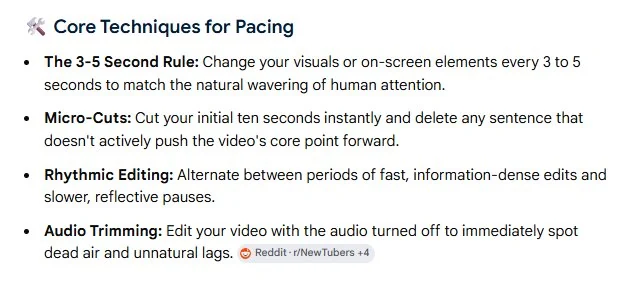
casinos engineer against habituation by randomising reward intervals. the slot machine doesn't pay out on a schedule. the randomness prevents the brain from building a prediction model. without a model to run, attention stays engaged.
scripts do the same thing through pacing dynamics: three modes that cycle deliberately to prevent calibration.
compression is where you pack dense information into short, rapid sentences. the viewer is slightly overwhelmed. they lean in. attention spikes.
expansion is where you slow down into story, analogy, or extended example. the viewer breathes. information they were holding gets processed and settled.
shock is where you violate the pattern entirely. a surprising data point, a direct challenge to something the viewer believes, a structural shift they didn't see coming. the brain's prediction model breaks. attention resets to full.
the compression-expansion-shock cycle isn't a formula. it's a tool. the rhythm of when you deploy each mode is a creative decision that depends on what the content demands.
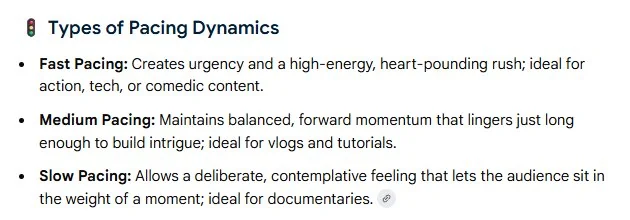
wanner aarts used this pacing architecture across a seven-email sequence to an email list everyone said was dead. seven emails, variable pacing per email, $35,000 in revenue. the list wasn't dead. the previous content was flat. flat content habituates. habituated audiences disengage.
principle 5: stakes engineering (the escalation loop)
stakes engineering is the systematic escalation of what the viewer stands to gain or lose by continuing to watch.
it works because of a specific feature of dopamine-driven motivation: the anticipation of reward activates the reward system more strongly than the reward itself. the brain's dopamine release peaks in the approach phase, not the arrival phase. this is why the slot machine's spinning reels are more engaging than the outcome.
a script engineered for stakes deploys this consistently: every 60 to 90 seconds, the perceived stakes of what's being revealed need to increase. the viewer shouldn't feel like they're accumulating information. they should feel like they're getting closer to something important, and that something keeps getting more important the closer they get.
scripts usually start at their highest stakes (the hook) and then flatten into information delivery. stakes peak at second 30 and drift down from there. this is backwards.
the correct structure starts at moderate stakes, escalates through the middle, and peaks at the payoff. the viewer feels like the video keeps getting more relevant to them the further in they go. the moment of maximum stakes is right before the grand payoff. that's when the viewer is most locked in. that's when you deliver.
ed applied this system across two faceless channels started from zero in january. by march, he'd made $50,000+. the scripts weren't complex. the editing wasn't cinematic. the stakes architecture was engineered across every video.
why this is a system, not a list of techniques
these five principles don't work in isolation. they compound.
hook confirmation creates trust. the curiosity gap creates compulsion. input bias creates perceived value. pacing dynamics create sustained attention. stakes engineering creates urgency. each one amplifies the others.
remove any single layer and the system degrades. which is why the common approach of "add a better hook" without addressing the pacing, the stakes, or the curiosity architecture produces marginal improvements at best.
the system as a whole is what's encoded in FacelessOS: 22 skill files trained on 8,000+ scripts across 50+ niches, each built around the five principles above. when you run a script through this system, it's structured to deploy each psychological mechanism at the right moment, not just written better.
300+ creators are using it. joey hit 863,000 views from one script. SoloGains hit 100,116 views. RK monetised in 3.5 hours.
these channels ran scripts built on the principles above - no secret niches.
if you want to go deeper on the curiosity gap mechanics and how to chain them specifically for faceless true crime versus educational content versus documentary formats, i break it down in the scriptwriting newsletter at fyreinteractive.co/newsletter. different content types need different chaining patterns and it's worth understanding the distinction before you apply it.
grab FacelessOS at fyreinteractive.co/facelessos if you want the full system.
(8,000+ scripts. $5M+ generated for clients. 22 skill files trained on pattern data across 50+ niches.)
haris
keep reading
Put this into every script you write
FacelessOS is 22 skill files built from 8,000+ scripts across 50+ niches. It works with any AI. 300+ creators are using it. $699 one-time for Files, $1,199 for FacelessOS+. No subscription.
Get FacelessOS