this one script generated 806,000+ views.
69,600+ watch hours. thousands of new subscribers. over $6,000 in direct revenue from a single upload on a faceless channel.
the channel's average was around 40,000 views per video. this script did 20x the baseline. and i've been getting DMs every week since asking the same question: "how did you make this work?"
so instead of replying to everyone individually with "write better content, bro," i'm going to dissect the entire script, principle by principle, and show you exactly why the retention graph looked the way it did.
the script was for "every time the world almost ended" on a faceless educational/entertainment channel. the topic is historical. the format is documentary-style countdown. the voice is dry, sarcastic, and conversational.
none of the structural decisions in this script were accidental. every one of them maps to a specific retention principle. here are all six.
principle 1: start with what's relatable, not what's chronological
the video covers extinction-level events spanning 74,000 years of human history. the obvious structure: start with the oldest event and work forward.
i didn't do this.
instead, i opened with the spanish flu of 1918. not the oldest event. not the most dramatic. the most relatable.
"2020 was a bad year for viruses. we can agree on that. but potentially 1918 was slightly worse. hear me out."
why this works: every viewer lived through covid. "2020 was a bad year for viruses" isn't a history fact. it's a shared experience. the viewer's brain doesn't need to process abstract historical context. the brain registers: "i remember that. i was there. this video is talking about something i understand."
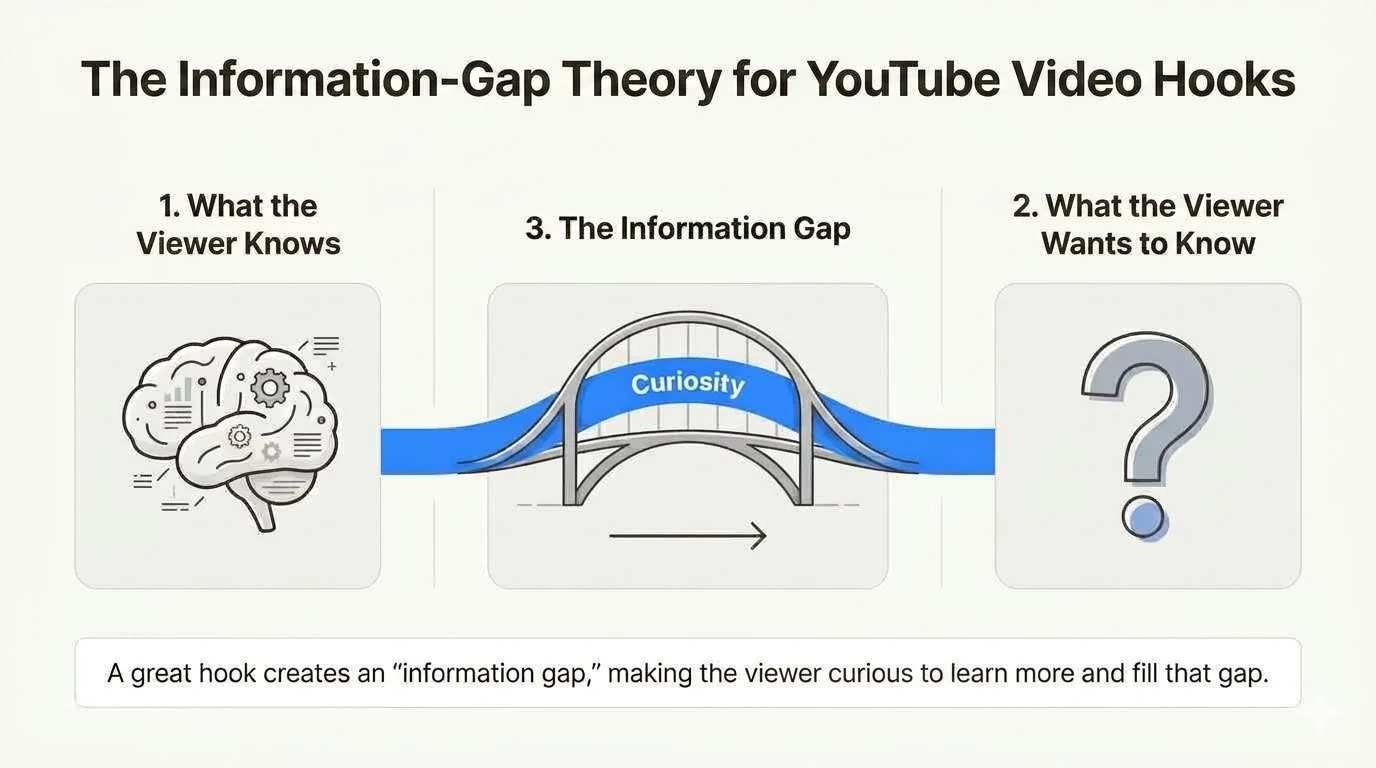
a great hook doesn't dump new information on the viewer immediately. it uses what they already know to build a frictionless bridge straight into the curiosity gap.
a great hook doesn't dump new information on the viewer immediately. it uses what they already know to build a frictionless bridge straight into the curiosity gap.
a great hook doesn't dump new information on the viewer immediately. it uses what they already know to build a frictionless bridge straight into the curiosity gap.
that recognition creates an immediate emotional connection. the viewer is anchored in personal experience before the script asks them to engage with something that happened 74,000 years ago.
if i had opened with the toba super-eruption from 74,000 BC, the first 30 seconds would have been spent building context for an event the viewer has no personal connection to. the brain's attention allocation system treats that as "new information requiring effort." starting with the spanish flu treats the opening as "confirmation of something i already know," which generates a dopamine signal rather than a cognitive demand.
the transferable mechanic:
always open with the event closest to the viewer's personal experience, regardless of chronological order. the viewer's engagement ceiling is set in the first 15 seconds by how quickly they connect the topic to their own life. chronological order serves the timeline. experiential order serves the retention graph.
this is straight out of the curiosity gap playbook. "hear me out" at the end of the opening creates the information deficit. the viewer knows something about 1918 that they didn't expect to learn. the gap opens. the brain demands resolution. the viewer stays.
principle 2: conversational language over academic language
the toba super-eruption ejected approximately 2,800 cubic kilometres of ash into the atmosphere.
that's a fact. it's accurate. and if i had written it that way in the script, the viewer would have felt like they were reading a wikipedia article. nobody watches youtube to read wikipedia.
here's how i actually wrote it:
"picture this. you're doing caveman stuff. then out of nowhere, the ground begins shaking. at first, you're annoyed because you think it's your neighbours. but it's not a nightmare. nope. there's ash. a lot of ash. like around 2,800 cubic kilometres of ash. i'd say somewhere in that ballpark."
same information. same number. completely different experience.
the conversational frame ("picture this, you're doing caveman stuff") places the viewer inside the scene rather than observing it from a textbook distance. the self-correction ("i'd say somewhere in that ballpark") mimics how a real person talks. the casual tone around a genuinely terrifying number (2,800 cubic kilometres) creates tonal contrast that makes the number hit harder, not softer.
if you want to see how this principle applies across different niche types (the conversational register for true crime is structurally different from educational content), i cover the niche-specific voice calibration in the newsletter at fyreinteractive.co/newsletter.
the transferable mechanic:
when delivering data, build the scene around the number rather than building the sentence around the number. "2,800 cubic kilometres of ash" is a statistic. "there's ash. a lot of ash. like around 2,800 cubic kilometres" is an experience. the viewer who experiences the data retains both the number and the emotional weight. the viewer who reads the statistic retains neither.
principle 3: modern references make history personal
when the script covered the cold war and the cuban missile crisis, the obvious approach would have been geopolitical analysis. alliances, treaties, nuclear deterrence theory.
instead:
"the cold war was two superpowers playing the most dangerous game of chicken the world has ever seen. on one side, the united states with its shiny new nuclear weapons. on the other, the soviet union with enough firepower to turn earth into a cheap glow stick. it was like two toddlers trying to press the big shiny buttons that would wipe everyone out."
"a cheap glow stick" translates global nuclear arsenals into something the viewer can visualise in their hand. "two toddlers trying to press buttons" translates mutually assured destruction into a behavioural reference every viewer understands intuitively.
if you want to see this principle executed at the absolute highest level, go watch Kurzgesagt. they are the masters of translating hyper-complex scientific theories into basic everyday language. whether they're comparing ant colonies to geopolitical empires or explaining general relativity using simple visual metaphors, they prove that the best way to explain a hard concept is to give the brain an image it can already understand.

if you want to see this principle executed at the absolute highest level, go watch Kurzgesagt. they are the masters of translating hyper-complex scientific theories into basic everyday language. whether they're comparing ant colonies to geopolitical empires or explaining general relativity using simple visual metaphors, they prove that the best way to explain a hard concept is to give the brain an image it can already understand.
if you want to see this principle executed at the absolute highest level, go watch Kurzgesagt. they are the masters of translating hyper-complex scientific theories into basic everyday language. whether they're comparing ant colonies to geopolitical empires or explaining general relativity using simple visual metaphors, they prove that the best way to explain a hard concept is to give the brain an image it can already understand.
the viewer doesn't need to understand nuclear deterrence theory. they understand toddlers fighting over a toy. the emotional truth of the situation (irrational behaviour with catastrophic consequences) lands through the analogy.
the transferable mechanic:
every historical or abstract concept has a modern equivalent the viewer understands intuitively. the scriptwriter's job is to find that equivalent and use it as the primary frame. the technical explanation is secondary. the emotional translation is primary.
the analogy must be vivid enough to create a mental image. "a cheap glow stick" works because the viewer can see it. "equivalent destructive capability" doesn't work because there's no image attached.
principle 4: emotional pacing through tonal contrast
this video covers topics where humanity almost went extinct. that's inherently heavy. the instinct is to match the tone to the gravity: dark, serious, intense throughout.
the problem: 15 minutes of unbroken intensity produces content fatigue. the viewer's emotional bandwidth saturates by minute 7. they disengage not because they lost interest, but because their capacity for processing dark material ran out.
the script deliberately alternates between serious treatment of the events and dry humour that acknowledges the absurdity without undermining the gravity.
"the dating pool consisted of a few of your relatives. it must have been pretty hard to choose who to make a baby with. it's like being on tinder in the middle of nowhere, with each swipe revealing someone that you share way too much DNA with."
this follows a section explaining that the human population dropped to approximately 1,280 individuals. the gravity of near-extinction is real. the humour doesn't dismiss it. the humour finds the human experience inside it.
the retention graph confirmed the effect. every transition from light to dark produced a retention peak. the tonal shift reset the viewer's emotional engagement, which meant each serious section hit with full emotional force rather than diminishing returns.
the transferable mechanic:
in scripts covering heavy topics, the humour is not a distraction from the content. the humour is a reset mechanism for the viewer's emotional processing system. without resets, the viewer saturates and leaves. with resets, the viewer can sustain engagement across the full runtime.
the humour must acknowledge the gravity. it must find the human absurdity inside the situation rather than trivialising the situation itself. the line between "finding the humour in a dark topic" and "making fun of a dark topic" is the line between retention and audience loss.
principle 5: mini payoff architecture
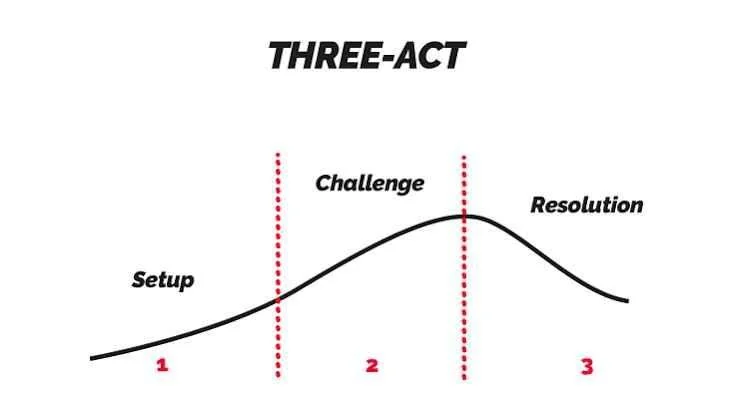
each extinction event in the script follows the same three-part structure:
- setup: introduce the event with a modern reference or personal anchor
- tension: describe how bad the situation was using visual language and specific numbers
- resolution: explain how humanity survived (or how close we came to not surviving)
every event is its own complete mini story. the viewer gets a payoff (the resolution) every 2-3 minutes.
think of your videos as a chain of miniature three-act movies. you carry the viewer over the peak of the challenge, give them a satisfying resolution, and then instantly escalate the stakes for the next section.
think of your videos as a chain of miniature three-act movies. you carry the viewer over the peak of the challenge, give them a satisfying resolution, and then instantly escalate the stakes for the next section.
think of your videos as a chain of miniature three-act movies. you carry the viewer over the peak of the challenge, give them a satisfying resolution, and then instantly escalate the stakes for the next section.
but here's the structural detail that separated this script from every other countdown video on the topic: after each mini payoff, the script explicitly escalates to the next item.
"okay, but the spanish flu only infected like 30% of the world. that was only 500 million people. it's time to go bigger."
"only 500 million people" reframes the previous event as small relative to what's coming. the viewer who thought the spanish flu section was intense now discovers the scale is about to increase dramatically. the next section has been pre-framed as more extreme before the viewer reaches it.
this is what creates the "compounding disbelief" effect. each mini payoff raises the bar for the next section. the viewer can't leave because the script just told them the next part is bigger than what they already found impressive.
the transferable mechanic:
the transition between mini payoffs is more important than the payoffs themselves. each transition must do two things simultaneously: resolve the current section (so the viewer feels satisfied) and reframe the next section as more extreme (so the viewer feels compelled to continue). resolution without escalation creates a comfortable exit point. escalation without resolution creates frustration. the combination creates momentum.
principle 6: visual language that doubles as an editing blueprint
"you walk outside and within minutes you're sizzling like bacon on a june sidewalk. your skin will peel right off and you won't even get to use aloe vera."
this line is doing two jobs at once.
job 1: it creates a mental image the viewer can see. "sizzling like bacon on a june sidewalk" is a specific, vivid picture. the viewer's brain generates the image automatically, which creates emotional engagement (disgust, discomfort) without the script having to explain "this would be very painful."
job 2: it tells the editor exactly what to show. the editor reads "sizzling like bacon on a june sidewalk" and immediately knows: bacon footage, hot sidewalk footage, visual effects of skin damage. the line is simultaneously a narrative beat and a production instruction.
most scripts separate writing from production. the writer writes. then the editor interprets. the interpretation gap (the distance between what the writer imagined and what the editor produces) creates inconsistency.
the transferable mechanic:
every line that describes a visual should be specific enough that an editor can produce the visual without asking a question. "the eruption was devastating" tells the editor nothing. "2,800 cubic kilometres of ash turning the sky black for a year" tells the editor exactly what footage to find.
visual language is not a literary choice. it's a production efficiency tool. the script that embeds visual direction into the narrative produces a better video and costs less editorial time because the interpretation gap doesn't exist.
why these six principles produced 806K views
none of these principles are exotic. none of them require special talent. every one of them is a structural decision made before the writing starts.
the in media res entry with modern anchoring was a structural decision: "start with the spanish flu, not the toba eruption." the conversational register was a structural decision: "write dialogue, not an essay." the tonal contrast was a structural decision: "insert a recovery beat between every dark section." the mini payoff architecture was a structural decision: "each event gets setup-tension-resolution, with escalation bridges between them."
the writing itself was relatively fast. the structural decisions took the thinking.
and that's the point. the script that does 20x the channel average doesn't come from better vocabulary or more research or flashier editing. the script comes from better structural decisions made before the first word is written.
these six principles run underneath every script i write. they run underneath every skill file inside FacelessOS. and they produce the same type of outlier results across 50+ niches because the principles operate at the level of human attention, not at the level of any specific topic.
the niche provides the content. the principles provide the architecture. the architecture determines whether the video does 40K or 806K.
if you want to grab FacelessOS and start writing scripts with the structural architecture behind 200M+ views of pattern data, go to fyreinteractive.co/facelessos
(8,000+ scripts. $5M+ generated for clients. 200M+ views. 22 skill files trained on pattern data across 50+ niches.)
haris
keep reading
Put this into every script you write
FacelessOS is 22 skill files built from 8,000+ scripts across 50+ niches. It works with any AI. 300+ creators are using it. $699 one-time for Files, $1,199 for FacelessOS+. No subscription.
Get FacelessOS