i've written 8,000+ scripts across 50+ niches.
that number matters because the rankings below come from pattern data - thousands of retention graphs, hundreds of channel audits, real revenue from creators who've run every format below in parallel.
not theory, and not one channel that got lucky in one niche for six months.
the format guides floating around online are mostly written by people who've tested two formats on one channel. here's the actual ranking, from worst to best, with the honest data behind each one.
the ranking criteria
every format below is scored on three things:
- average retention performance: how consistently does this format hold viewers past the 0:30 mark, past the midroll markers, and to the end?
- RPM output: does this format attract the viewer profile that generates ad revenue, or does it optimise for view count at the expense of earnings?
- monetisation safety: does this format pass youtube's authenticity and originality checks, or does it create risk?
#8 (worst): the slideshow compilation
the bottom slot belongs to the format that barely qualifies as a format.
a slideshow compilation is a series of images or text cards with an AI voiceover reading information aloud over them. no narrative. no retention architecture. no editorial direction.
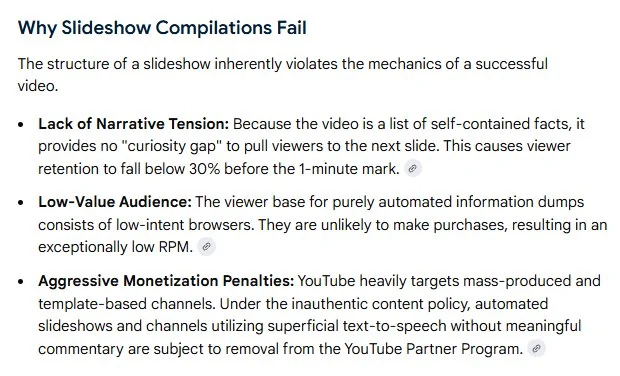
- retention: drops below 30% at the 1-minute mark on virtually every channel that tries it. the format provides no mechanism to hold attention because there's nothing pulling the viewer forward. each card is a self-contained piece of information with no curiosity gap into the next.
- RPM: extremely low. the viewer profile attracted to pure information dumps without narrative tends to be low-intent browsers. not buyers. not decision-makers.
- monetisation safety: this is the format youtube explicitly called out in the july 2025 policy update. "slideshow compilations with reused clips" is listed verbatim as content at risk of demonetisation.
if you're making slideshow compilations, stop. not because they're hard to make, but because they're actively damaging every other metric on your channel through the negative watch signals they generate.
#7: the pure listicle (no bridging)
the listicle works fine as a format.
what breaks it is the missing bridging sentences.
the default move is to treat a listicle as a numbered list with a paragraph about each item. the problem: each item is a complete, self-contained payoff. once the viewer gets the payoff for item 3, they have no psychological pull to continue to item 4.
the retention graph looks like a staircase. each step down is a completed payoff with nothing pulling the viewer to the next one.
- retention: average 40-50% at the 30-second mark, declining steadily through the body. by item 5 of an 8-item list, you've lost 60% of your audience.
- RPM: moderate. depends heavily on niche. the format works in high-RPM niches because it attracts intent-based viewers searching for specific information.
- monetisation safety: reasonably safe if the content is original. risk comes from generic AI output using this format, which produces the flat rhythm the classifier flags.
the fix is the waterfall effect. instead of completing each item and moving on, end every item with a sentence that makes the next one feel essential. "but this isn't even the worst one on this list. this next format actively works against you in ways you won't catch until you check your revenue numbers."
that one sentence is the difference between a staircase retention graph and a relatively flat one.
the listicle with bridging sentences is actually a strong format. the listicle without them is almost guaranteed to underperform.
#6: the explainer
the explainer format answers a question. "why do planes leave contrails?" "how does the federal reserve actually work?" "what happens to your body after you die?"
it's the most academically honest format and the one most likely to sound like a wikipedia article narrated by a text-to-speech model.
- retention: highly variable. explainers that use the context-action-context-action structure hold 55-65% at the 30-second mark. explainers that dump context first and demonstrate later drop to 35-40%.
- RPM: strong. explainer content attracts curious, research-oriented viewers. CPM is above average across most explainer niches.
- monetisation safety: moderate risk. the format is highly susceptible to AI slop output because "explain this topic" is the most common raw AI prompt. the classifier sees thousands of explainer-format scripts with identical rhythm and vocabulary clustering.
the explainer works when the script frames the explanation as a journey rather than a lecture. the viewer should feel like they're figuring something out alongside the narrator, not being taught by one.
the explainer fails when it front-loads context before demonstrating anything. the context dump kills explainer retention faster than any other mistake in this format.
#5: the countdown
countdowns are structurally engineered for the listicle's main weakness: the waterfall effect is built in.
"number 10 on this list is impressive. but wait until you see what's at number 1" is not a clever hook trick. it's the fundamental structure of the format. the countdown creates a built-in hierarchy that makes each completed item feel less important than the ones still coming.
- retention: 55-65% at the 0:30 mark consistently. the format's structural pull is strong enough to hold viewers through the middle sections even without sophisticated curiosity chaining.
- RPM: moderate to strong. depends on niche. finance and business countdowns perform well. gaming countdowns have high view counts but lower CPM viewer profiles.
- monetisation safety: good. the countdown is an inherently editorial format that requires a human to have made ranking decisions. the classifier reads this as genuine creative direction.
the countdown fails when the quality of the ranked items doesn't justify the hierarchy. if items 10 through 6 are weak, the viewer learns early that the ranking is arbitrary and stops trusting the payoff. the best countdown scripts front-load the second-best item (not the worst) to establish credibility, then escalate.
#4: the case study

the case study is the format with the highest revenue correlation of anything on this list, and it's criminally underused by faceless creators who are still chasing view count instead of RPM.
a case study walks through a specific situation, the decisions made, and the outcome. "how a 23-year-old with no experience built a $40K/mo youtube channel in 90 days." "how one script generated $6,137 from 225,000 views."
- retention: 60-70% at the 0:30 mark when structured correctly. the narrative arc of a case study (situation, problem, decision, outcome) mirrors the mini payoff loop structure that holds retention through the body.
- RPM: the highest of any format i've tested at scale. case study viewers are high-intent — people actively trying to achieve a specific outcome. the advertiser recognises this and bids accordingly. CPM on well-positioned case study content runs 40-60% above category average.
- monetisation safety: excellent. a genuine case study with specific names, numbers, and decisions is the clearest possible signal of original content with real human direction.
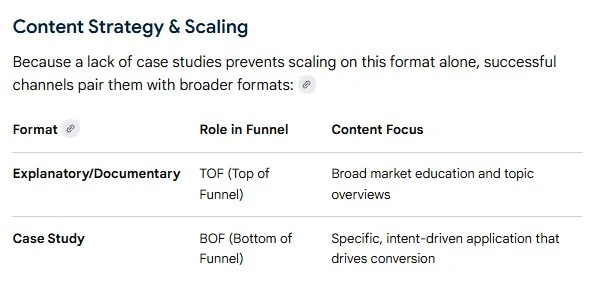
the case study fails at scale because most creators don't have enough case studies to sustain a channel on the format alone. the solution is mixing case studies with other formats, using the case study as the BOF content that converts viewers already warmed up by your explanatory and documentary content.
#3: the hero's journey / biographical documentary
this is the format the celebrity documentary skill file in FacelessOS is built around.
a biographical documentary tracks one person's rise, peak, fall, and resolution. the format works because it activates every psychological trigger simultaneously: character investment, curiosity about the outcome, emotional pacing from peaks to valleys, and the grand payoff (how did they end up?) that pulls the viewer through the entire runtime.
- retention: 65-75% at the 0:30 mark. the biographical format has the most consistent retention shape of any narrative format. it doesn't peak at the hook and decline. it builds through the middle because the story escalates naturally.
- RPM: strong. biographical documentary viewers are highly engaged, not casual browsers. the format attracts the viewer profile that watches through the midrolls.
- monetisation safety: excellent. the format is inherently editorial — it requires genuine research, specific people and events, and a narrative arc built by a human. the classifier reads it as original content.
the hero's journey fails when the creator picks subjects with weak narrative arcs. the format needs genuine tension: a peak that feels significant, a fall that feels earned, a resolution that reframes everything. pick subjects with low dramatic stakes and the format deflates.
#2: the true crime / mystery documentary
the format with the highest average watch time of anything i've tested.
true crime and mystery documentary scripts run on the format that most directly exploits the zeigarnik effect: the unresolved loop. the viewer doesn't know who did it, or how, or why, and the script chains these gaps so tightly that leaving before the resolution feels physically incomplete.
- retention: 70-80% at the 0:30 mark on scripts with proper curiosity architecture. the true crime format, when executed correctly, produces the flattest retention graphs i've seen. the cliff that shows up in every other format barely exists here.
- RPM: moderate. true crime CPM varies significantly by niche angle. cold case and unsolved mysteries tend to higher CPM than true crime adjacent. crime adjacent finance (ponzi schemes, financial fraud) runs the highest CPM of any true crime subformat.
- monetisation safety: good, with caveats. the format requires genuine research and original analysis. scripts that repackage existing true crime content without adding a point of view get flagged as "reused content." scripts with genuine investigative framing pass easily.
the true crime skill file in FacelessOS handles the mystery pacing specifically: how to sequence reveals to maximise the length of each unresolved loop, when to deliver partial resolution to create a new gap, and how to build the reveal without telegraphing it.
joey hit 863,000 views with one true crime-adjacent script. 69,600 watch hours. the format holds retention and generates the kind of watch time that makes monetisation review a formality.
#1 (best): the celebrity documentary
the format that combines the highest retention ceiling with the highest RPM profile and the strongest monetisation safety score of anything on this list.

a celebrity documentary takes the biographical structure and applies it to a subject the viewer already has emotional investment in. that pre-existing investment means the hook doesn't have to build character from zero — the viewer is already curious about what happened and why.
- retention: 75-85% at the 0:30 mark on scripts with proper celebrity documentary structure. this is the highest ceiling of any format. the combination of character pre-investment and narrative arc produces a retention shape that almost no other format can match.
- RPM: highest of any format i've tested. celebrity documentary viewers are high-intent, high-income, high-engagement. the advertiser knows this. CPM on well-targeted celebrity documentary content runs 60-80% above category average.
- monetisation safety: excellent. original celebrity documentary content with genuine research, specific sourcing, and a clear editorial perspective is the opposite of the content youtube's classifier flags. it's the proof of human direction at scale.
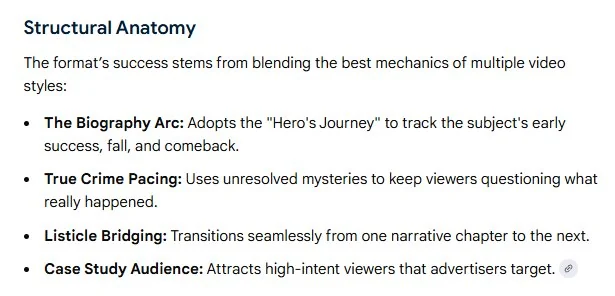
the celebrity documentary works because it combines every structural advantage from the formats above it in the ranking:
- the biographical arc from the hero's journey
- the mystery pacing from true crime (what really happened?)
- the built-in hierarchy from the countdown (from early success to the fall to the comeback)
- the high-intent viewer profile from the case study
- the bridging structure from the listicle (each chapter sets up the next)
FacelessOS's celebrity documentary skill file is the most-used file in the system. it's the format that produces the most consistent results across the widest range of niches. it's also the hardest to replicate with a raw AI prompt because it requires the most sophisticated structural understanding of any format on this list.
the honest summary
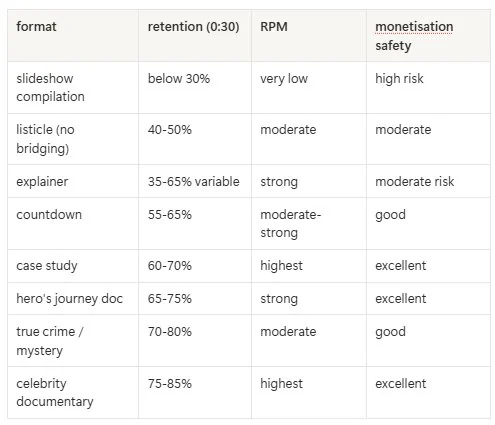
the takeaway is simple: your format selection determines your ceiling before you've written a single word. that doesn't mean only make celebrity documentaries - it means the format you pick sets the limit you're writing toward.
if you want to go deeper on how to apply these rankings across different niche categories and where each format outperforms its average in specific contexts, i cover that in the scriptwriting newsletter at fyreinteractive.co/newsletter.
and if you want the full skill file system for the top three formats on this list, celebrity documentary, true crime, and hero's journey, they're all inside FacelessOS at fyreinteractive.co/facelessos along with 19 other skill files built from 8,000+ scripts of pattern data.
if you want to grab FacelessOS and start running the formats with the highest retention ceiling, go to fyreinteractive.co/facelessos
(8,000+ scripts. $5M+ generated for clients. 22 skill files trained on pattern data across 50+ niches.)
haris
keep reading
Put this into every script you write
FacelessOS is 22 skill files built from 8,000+ scripts across 50+ niches. It works with any AI. 300+ creators are using it. $699 one-time for Files, $1,199 for FacelessOS+. No subscription.
Get FacelessOS