in august 2025, something happened that broke thousands of faceless channels.
desktop traffic fell from 56% to 39.3% almost overnight. that's a 16.7 percentage point drop in days, not weeks. channels that had been stable for months reported viewership declines they couldn't explain.
then mario joos - the retention director behind channels with 100M+ subscribers including some of the biggest names on the platform - published an analysis of over 1,000 channels.
his finding: up to an 80% reduction in long-form video recommendation on the home feed.
the creator community panicked. "long form is dead." "youtube is killing the algorithm." "pivot to shorts immediately."
all wrong conclusions. all of them.
i'm going to break down what actually changed, why the response most creators are having will make them worse off, and what the algorithm is actually rewarding right now - which is the same thing it's always rewarded, just with less room for weak signals to slip through.
what the data actually says
start with what youtube's CEO said directly. neil mohan, on the record, has been saying the same thing for two years.
"i can tell you for a fact that it's not the algorithm. it really just is being true to yourself."
then the october 2025 alphabet earnings call made it clearer. sundar pichai's statement: shorts now earn more revenue per watch than traditional in-stream in the US, and their recommendation systems are "driving robust watchtime growth in our key monetisation areas like shorts and living room."
living room. that's where the distribution shift actually went. not away from long form. toward TV viewing. youtube is now the number one streaming platform in america with over a billion hours watched on TVs daily.
the algorithm didn't start penalising long form. it’s distributing long form differently - to different surfaces, at different times, driven by different watch signals.
what changed is the precision of those watch signals. the algorithm has more data now. it's better at distinguishing content that genuinely holds attention from content that gets clicked and abandoned.
and that precision is exactly what's killing channels with weak script architecture.
why the gemini integration changed everything
youtube has been integrating gemini into its content classification systems throughout 2025 and 2026.
what this means practically: the platform now has significantly more sophisticated transcript analysis running on every video. the signals it extracts from your script - structure, rhythm, authenticity, retention architecture - are being read with more granularity than they were 18 months ago.
the creator who was getting away with flat AI scripts in 2024 is getting caught now. youtube didn't add a new rule. the classifier got smarter.
here's what it's detecting more accurately:
structural flatness. a script where every paragraph runs to roughly the same length, every transition uses the same generic connector, and no section has a deliberate compression-expansion cycle reads as low-engagement content before a single viewer watches it. the classifier flags it as content unlikely to hold retention.
authenticity absence. content with no genuine editorial direction - where information is delivered without a point of view, without specific examples chosen by a human, without the organic variation that comes from a real person constructing an argument - gets classified as "minimal human involvement." this triggers the flags from the july 2025 policy update.
hook failure patterns. the algorithm can now identify the specific opening structures that correlate with early viewer drop-off. "hey guys, welcome back to the channel" as the first words is a known early-drop-off predictor. the platform uses this to weight initial distribution downward for content matching these patterns.
the response that makes things worse
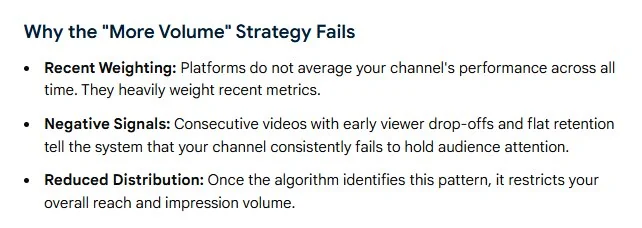
when channels see viewership drop, they respond by uploading more.
the logic: if a few videos aren't getting traction, maybe volume will compensate.
this is backwards.
uploading more weak-signal content faster sends a stronger signal to the algorithm that your channel is a low-quality operation. the platform doesn't average your performance across uploads. it weights recent performance heavily. 10 videos in 2 weeks that all show early viewer drop-off and flat retention graphs tell the algorithm: this channel doesn't hold viewers. reduce distribution.
the creators gaining ground right now are uploading less and producing scripts with significantly stronger retention architecture.
the data from the channels i monitor: creators posting 3-5 shorts weekly alongside 1-2 long-form videos are seeing subscriber growth rates increase by 67% compared to single-format channels - but only when the long-form content holds retention past the 3-minute mark.
shorts for discovery. long form for depth, retention, and monetisation. but the long form has to actually hold viewers or the whole system fails.
what the algorithm is actually rewarding
forget what pundits are saying. look at what's performing.
the channels growing right now in long form share three structural characteristics in their scripts:
one: hook confirmation within 15 seconds. the viewer who clicked knows within 15 seconds that they clicked right. no warm-up. no topic setup. direct confirmation that this video delivers what the thumbnail promised. the algorithm sees viewers staying through the first 30 seconds and expands distribution.
two: payoff loops with no void. every piece of value is followed immediately by a new curiosity gap. the viewer is never in a state of completion long enough to make a rational decision to leave. watch time accumulates across the full video rather than peaking at the hook and declining through the body.
three: editorial voice that passes authenticity checks. the script reads like a human with a specific perspective on the topic made deliberate choices about what to include, how to frame it, and when to vary the pace. the classifier reads this as genuine creative direction. distribution expands.
the channels failing share the same three failure modes: hook that delays confirmation, body that produces a payoff void at minute 4-5, and script that reads as assembled rather than created.
the algorithm rewards the same thing it always has.
it just measures it better now.
the practical fix
creators are asking "how do i game the gemini algorithm?"
this is the wrong question.
the right question is: "how do i build a script that the algorithm correctly identifies as high-quality content?"
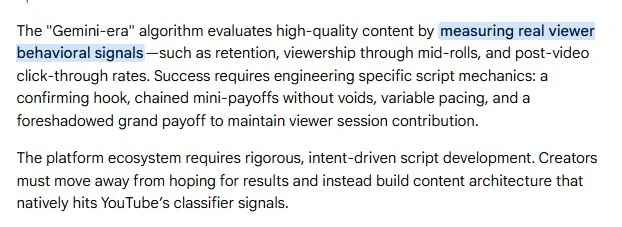
because the algorithm is doing something simple: measuring what viewers actually do - whether they stay, whether they watch through the mid-roll markers, whether they click to the next video after finishing.
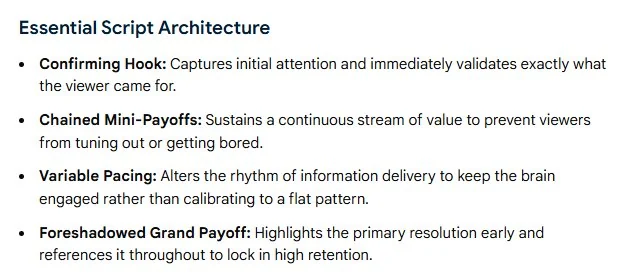
the scripts that produce those behaviours have a specific architecture. hook that confirms. body that chains mini payoffs with no void. pacing that prevents the brain from calibrating to a flat rhythm. grand payoff foreshadowed three times so viewers never forget why they clicked.
i've been building this architecture into scripts for 8,000+ videos across 50+ niches. i built it into FacelessOS so the system applies it to every script by default. the authenticity audit file in v4 specifically checks scripts against youtube's classifier signals before you upload.
no FacelessOS member has been demonetised since v4 shipped with the authenticity audit.
the creators gaining ground in the gemini era have one thing in common: their scripts generate the watch signals that the algorithm now has the precision to correctly reward. posting three times a week and hoping doesn't.
if you want to go deeper on how the algorithm changes affect retention architecture specifically for long-form versus short-form content, i break it down weekly in the scriptwriting newsletter at fyreinteractive.co/newsletter.
grab FacelessOS at fyreinteractive.co/facelessos if you want the full script system built for this environment.
if you want to start building scripts the new algorithm correctly rewards, go to fyreinteractive.co/facelessos
(8,000+ scripts. $5M+ generated for clients. 22 skill files trained on pattern data across 50+ niches.)
haris
keep reading
Put this into every script you write
FacelessOS is 22 skill files built from 8,000+ scripts across 50+ niches. It works with any AI. 300+ creators are using it. $699 one-time for Files, $1,199 for FacelessOS+. No subscription.
Get FacelessOS