
there are creators uploading 4 videos a week who have never once written a script on purpose.
they have a topic, an outline they threw together in 20 minutes, and a vague sense that the beginning should be interesting. the rest is instinct. and instinct produces a channel that plateaus somewhere between 800 and 3,000 views per upload forever.
i've written 8,000+ scripts across 50+ niches and generated 200M+ views doing it. what follows is the entire architecture, in the order the pieces actually get built.
not tips. the building blocks.
the mental model everything else hangs off
think about a faceless video as 3 blocks stacked on each other.
block 1 is packaging. the concept, the title, the thumbnail. this decides whether anyone clicks.
block 2 is the script. this decides whether anyone stays.
block 3 is production. editing, voiceover, music, b-roll. this decides whether the experience feels professional.
nearly every creator builds these in the wrong order. they brainstorm topics on monday, design a thumbnail on tuesday, and write the script last while hoping it fits the packaging they already committed to.
the outliers invert it. the script concept comes first, the packaging is built from the concept, and the script proves the concept for the full runtime.
everything below assumes that order.
BLOCK 1: THE SCRIPT CONCEPT
the difference between an idea and a concept
an idea is a topic. "the titanic disaster." "the fall of enron." "the most dangerous roads on earth."
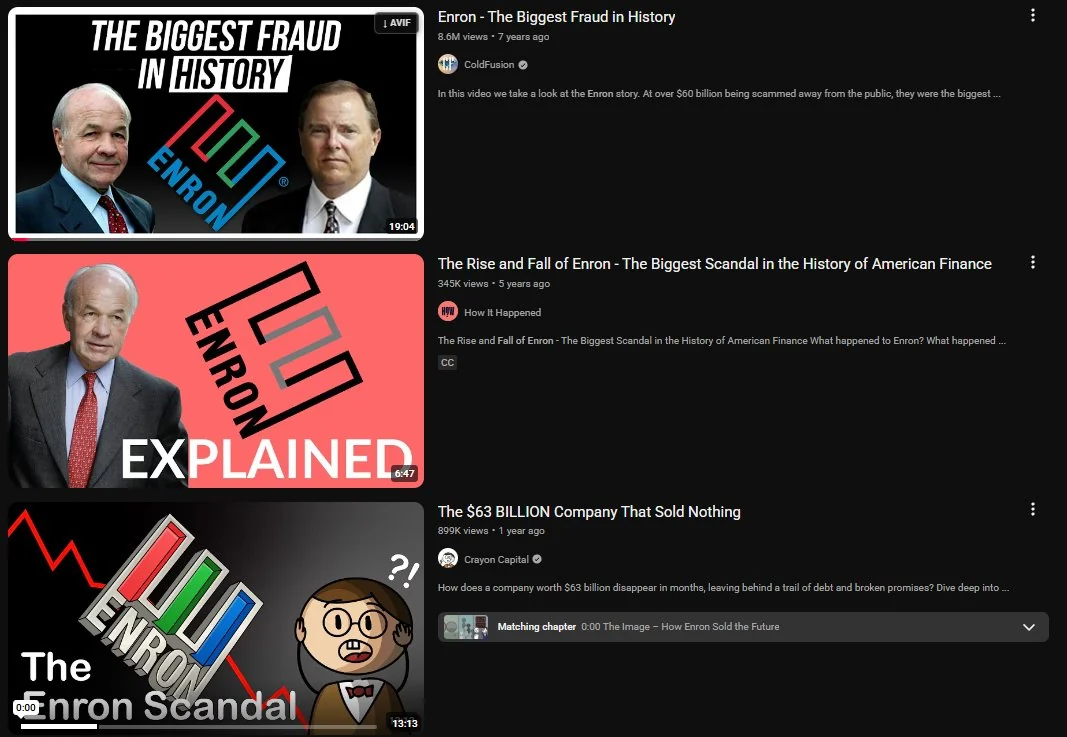
a concept is the specific angle that makes someone click YOUR video instead of the 100 others covering the identical subject.
"the titanic disaster" is an idea. 1,000s of videos own that ground already.
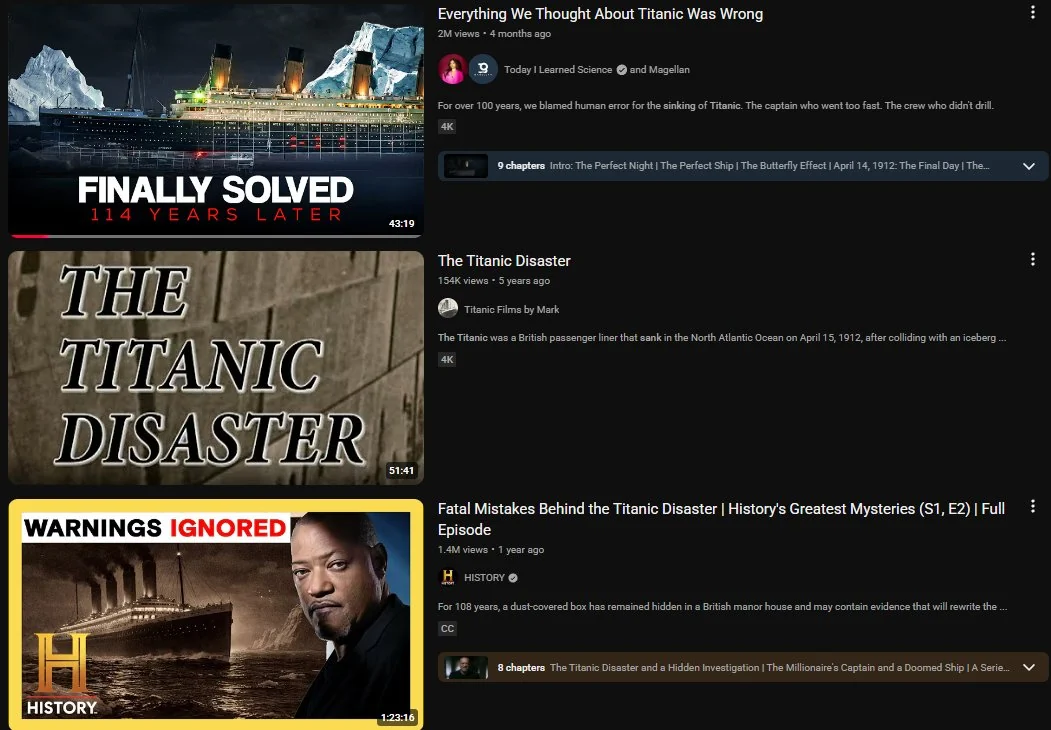
"the titanic wasn't sunk by an iceberg. it was sunk by a decision made 6 months before it left port" is a concept. it takes 1 aspect of the story, promotes it to the central thesis, and promises a perspective the viewer hasn't encountered.
the concept is what the title communicates, what the thumbnail visualises, what the hook confirms, and what the script spends 12 minutes proving.
how to find concepts without brainstorming
brainstorming starts at 0 and hopes to land somewhere interesting. the hit rate is miserable.
the method that works runs backwards. find videos already performing at 5 to 20x their own channel's baseline, then extract what made the angle work.
a video beating its own channel average by 8x is a controlled experiment. audience size, production, and editor all held constant. the concept was the only variable.
pull the transcripts of your niche's top 5 outliers. read them side by side and ask 1 question of each:
"what was the single most interesting PART of this topic, and how did the creator make THAT part be the entire video?"
that answer is the concept. everything else in the video was in service of it.
why the peak matters more than the coverage
there's a cognitive bias called the peak-end rule. viewers remember the most intense moment of an experience and the ending. the middle blurs.
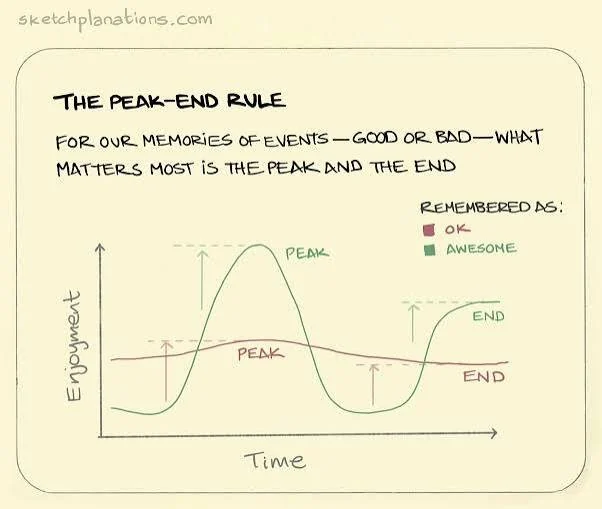
a topic video spreads intensity flat across 12 minutes. no peak, no valley, a straight line of competent information delivery. the viewer files it as "fine" and never thinks about the channel again.
a concept video concentrates everything around 1 angle. the peak IS the angle. the script builds toward it and resolves on it.
youtube's 2026 algorithm is built to detect exactly this difference, because satisfaction scoring now outweighs raw watch time in the ranking formula.
BLOCK 2: THE HOOK
pick the framework before you write a word
educational content and faceless content run on separate psychology.
educational uses target-transformation-stakes. who is this for, what will they get, why should they care.
faceless uses character-concept-stakes. who is the story about, what is the situation, why does it matter.
i'd estimate 95% of creators are crossing these, which is why their retention is flat regardless of content quality. a faceless channel opening with "if you want to understand criminal psychology, i'm going to teach you..." has pitched an audience that showed up to be entertained.
the first 8 seconds formula
every high-retention faceless hook i've written across 8,000+ scripts contains 3 components inside the first 8 seconds.
pattern interrupt. a detail unusual enough that the brain flags the moment as worth processing. "9 hikers cut their way out of their tent from the inside." the brain stops on it. why from the inside?
specific proof. a data point concrete enough to trigger specificity bias. "february 2nd, 1959. minus 30 degree weather. chest trauma equal to a car crash, but 0 external wounds." precision reads as REAL. round numbers read as invented.
open loop. the unresolved question that makes leaving feel incomplete. "soviet investigators wrote 3 words in the final report: compelling natural force. then they classified the case for 30 years."
all 3 inside the first 3 lines. line 1 is the entry point, line 2 adds tension, line 3 opens the loop.
the 4 types you rotate between
- in media res. drop into the middle of the action, before any context exists.
- contradiction. present something that shouldn't be possible.
- impossible result. state an outcome so clean the brain has to verify it.
- prediction bomb. project a negative future they haven't considered. loss aversion runs 2x stronger than desire for gain.
rotating across all 4 stops your returning audience from recognising the pattern and switching off before you've finished the sentence.
if you want me to look at your channel and show you which of these your niche responds to, DM me "COOK" and i'll walk you through it.
BLOCK 3: THE BODY
this is where 60% of viewers normally leave, and where almost nobody does deliberate work.
the context to action ratio
context is explaining. action is showing.
the rule that has held across every niche i've written in: 30 seconds of context, 60 seconds of action or concrete example. then repeat.
stack context without demonstration and retention drops immediately. across the scripts i audit, the ones burying value behind 90 seconds of setup lose most of their first-minute audience, and the ones leading with demonstration hold roughly double.
teaching someone a board game works the same way. you don't recite the rulebook and then let them play. you teach 3 rules, let them move a piece, and explain the nuance when it comes up.
mini payoffs and the payoff void
your body needs a small payoff every 90 to 120 seconds. a resolved question, a delivered insight, a revealed detail.
but a payoff without a following gap is a trapdoor.
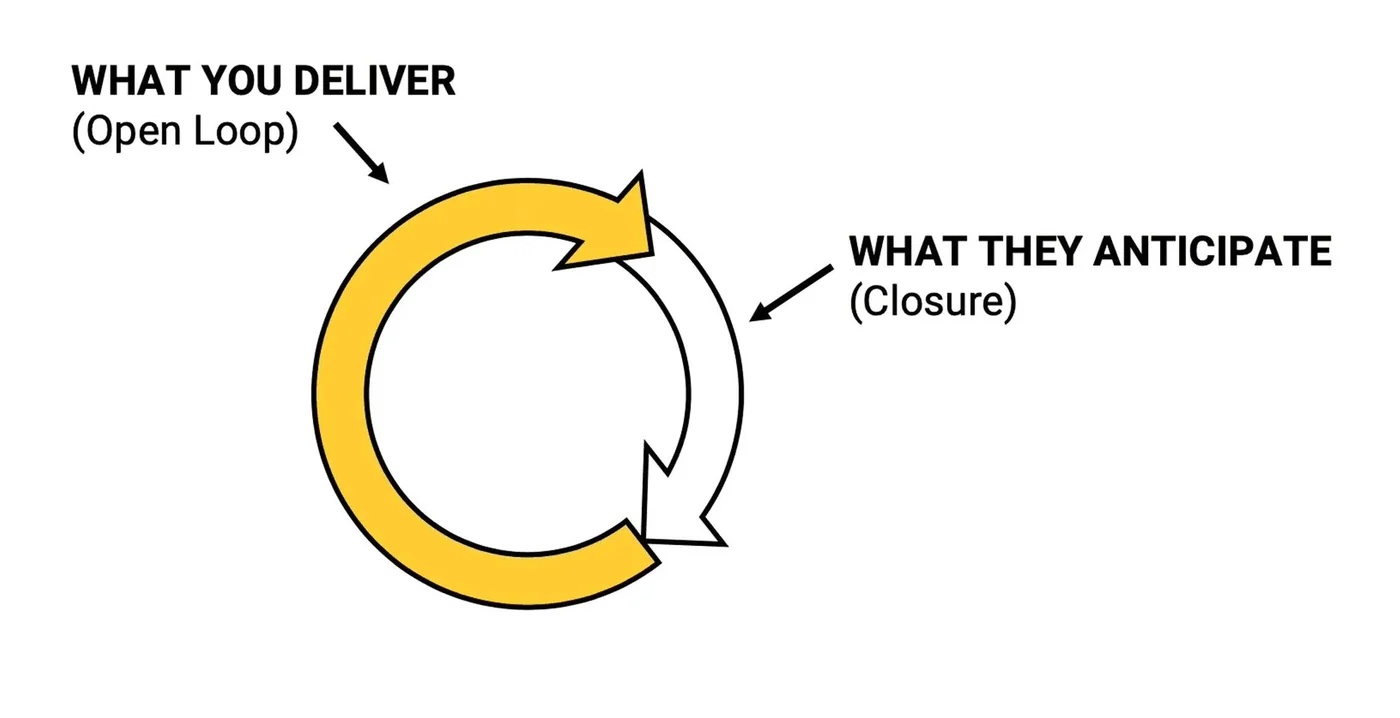
the mechanic almost nobody accounts for: you choose where your mid-rolls land, and most creators drop them at the satisfying moment, right after a payoff resolves. in most of the scripts i audit, the creator delivers a mini payoff, moves to the next section without opening anything new, and has an ad break sitting inside the dead zone.
for 30 to 60 seconds the viewer sits in a state of completion. they received value. leaving costs them nothing.
the ad fires directly inside that window.
they leave before it plays. they counted as a view on your dashboard and generated $0.
the fix is 1 sentence. within 10 seconds of every mini payoff, open the next gap. "but this leads somewhere far worse." "and the next section contradicts everything i showed you a minute ago."
then move your ad breaks off the payoffs and into the open gaps. an ad playing to someone who needs the next 30 seconds gets watched. an ad playing to someone who feels finished gets abandoned.
a channel doing 800,000 views a month at $2,400 revenue ran this fix and nothing else. RPM went from $3 to $14.50 and revenue climbed to $5,800, while views fell to 400,000.
reach dropped because tighter writing filtered the audience. the drive-by half stopped clicking, the half who finish stayed, and youtube started serving a smaller and far more valuable segment.
point ordering
every instinct says lead with your strongest material.
the instinct is wrong.
lead with your 2nd best point, put your BEST in the middle, and close with your 3rd best.
open with the strongest and the only direction left is down. the viewer's brain reads a declining trajectory and concludes it already got the good part. open with the 2nd best and the trajectory climbs, the midpoint lands as an escalation, and the video FEELS like it kept improving.
across my database, 2nd-1st-3rd ordering beats 1st-2nd-3rd by 15 to 25% on completion rate with identical content.
curiosity spacing, calibrated by niche
"plant curiosity gaps throughout" is advice that means nothing. how often, and based on what?
the interval changes by niche:
- mystery and true crime: every 30 to 45 seconds. the audience is in detective mode and processes faster.
- educational: every 45 to 90 seconds. they need absorption time or the pacing feels manipulative.
- documentary and biographical: roughly every 60 seconds. matches expected narrative progression.
anticipatory attention triggers
certain transition phrases put the brain into a measurable state called anticipatory attention. alertness rises, processing accelerates, and the viewer is primed before the information lands.
"but here's what they didn't know."
"what happened next changed everything."
"the real story is worse."
scripts without these triggers lose 60% of viewers by minute 3. scripts with them placed on the correct niche interval hold 75%+ into the final third.
the rule that makes them work: each one must introduce genuinely NEW information within 15 to 30 seconds. "and it gets crazier" with nothing behind it is an empty promise, and the audience learns to ignore you.
foreshadow the payoff 3 times
your hook made a promise. by minute 8, does the viewer still remember it?
in most scripts i audit, no. the promise was made once and then the script wandered.
- hook: establish the promise.
- minute 3: reinforce it and raise the stakes on what's still coming.
- minute 8: escalate it right before delivery.
scripts holding 60 to 70% retention through the final third all foreshadow at least 3 times. scripts collapsing to 30% in the last 2 minutes almost never foreshadow past the hook.
BLOCK 4: THE OUTRO
the outro is not a summary. summaries are where subscribers go to die.
it has 2 jobs: reinforce the transformation, and give a specific next action.
the structure i use is reframe, reveal, redirect.
reframe what they just learned in a wider context. "so while the case stays unsolved, what we know now changes how anyone should read small-town disappearances."
reveal that more exists. "because this case fits a pattern investigators are only starting to map."
redirect to the next piece of content. "next week we're covering 3 more that share the same connection."
the reframe satisfies the current curiosity so nobody feels cheated. the reveal opens a fresh gap. the redirect makes your channel the only place that gap closes.
this is the zeigarnik effect used deliberately. the brain retains incomplete tasks better than completed ones, so you hand them an incomplete task on the way out.
"if you enjoyed this, subscribe" does none of that work.
BLOCK 5: VISUAL SCRIPTING
a script that a human has to interpret is a script that gets interpreted badly.
every transition, every emphasis, every emotional beat should carry a marker your editor executes without a phone call. [B-ROLL], [CLIP], [TEXT], [HOLD].
and the visual pacing has to track the narrative pacing:
- hook section: cuts every 3 to 5 seconds
- context section: cuts every 5 to 8 seconds, slower transitions, processing room
- escalation: cuts tighten progressively from 6 seconds down to 3 as tension builds
- payoff: HOLD. 2 to 3 seconds longer than feels comfortable. let the revelation land
editing at a constant tempo regardless of what the script is doing is one of the most common reasons a good script underperforms. the words and the visuals end up fighting instead of compounding.
BLOCK 6: THE AUTHENTICITY LAYER
this block did not exist 3 years ago and now it decides whether you get paid.
youtube's classifier reads your transcript and evaluates structural patterns to determine whether a human wrote it. the checks worth running before every upload:
- vocabulary scan. roughly 40 words cluster in generated output across every model. delve, realm, tapestry, furthermore, shed light, testament, illuminate. 1 instance is noise. 3 in a script is a signal.
- rhythm variation. 3 consecutive sentences of similar length reads as mechanical to the classifier and boring to the human. vary deliberately.
- editorial perspective. does each major section contain a real opinion or reaction? information without a point of view reads as data. information with "this is the part that gets me" reads as authorship.
- specificity. "many creators struggle here" is generic. "a creator i audited last month sat at 42% retention at the 0:30 mark and switched niche 3 times chasing the wrong variable" is specific enough that a human clearly chose it.
specificity is doing double duty across this entire article. it builds trust with the viewer AND it clears the classifier. that's why it shows up in the hook block, the body block, and here.
BLOCK 7: THE FEEDBACK LOOP
the last block is the one that compounds.
after every upload, pull the retention graph and map the drop-offs against the script. which section lost them? what was happening structurally at that timestamp? was a gap open, or had you just delivered a payoff and moved on?
that mapping is how the system calibrates to YOUR audience instead of the average audience. the intervals in this article are the starting point. your channel's real numbers refine them.
the objection
"this is a lot of process for a youtube video."
it's a lot of process for the FIRST 20 videos. after that the blocks stop being conscious decisions and become how you think about a topic. the creators still winging it at video 200 are the ones capped at 3,000 views, and they've now spent 200 videos worth of effort to stay there.
the second objection
"why not write a good story and let the story work?"
a good story with no hook framework, no gap chaining, and a payoff void at minute 3 is a good story nobody finishes. structure is what carries the story past the points where attention naturally breaks.
i publish more of these breakdowns every week: fyreinteractive(.co/newsletter)
every block above compounds into the next. the concept determines the packaging, the packaging sets the promise, the hook confirms it, the body sustains it, the outro converts it, and the retention data sharpens all of it for the next script.
if you want me to audit your faceless youtube channel and show you how i'd install this entire system on your scripts using retention data from 8,000+ scripts across 50+ niches, DM me "COOK" and i'll show you how FacelessOS does this on autopilot
(200M+ views generated through AI scriptwriting skill files trained on 8,000+ scripts across 50+ niches, one-time payment)
haris
keep reading
Put this into every script you write
FacelessOS is 22 skill files built from 8,000+ scripts across 50+ niches. It works with any AI. 300+ creators are using it. $699 one-time for Files, $1,199 for FacelessOS+. No subscription.
Get FacelessOS